Futurepath: Energy [1]
 From ultra-modern Manhattan penthouses to cell phones and radios in sub-Saharan homes, from private jets zipping over the oceans to motor scooters in southeast Asia - we require energy to power our lives. At this point, only protected Amazon tribes and the few humans who have chosen to live off the energy grid do not use any of the world's energy supplies.
Overall, we humans use in excess of 500 exajoules of energy per year. The energy we produce is derived by a variety of sources such as nuclear; fossil fuels, including coal, crude, and gas; and renewables such as wind, hydro, and solar. These fuels are broken into two main types of use, the first is locomotion via fuel burning engines and the second is the creation of electricity, which is then used as a source of power for motors, lights, appliances, and the gadgets we use (to name a few).
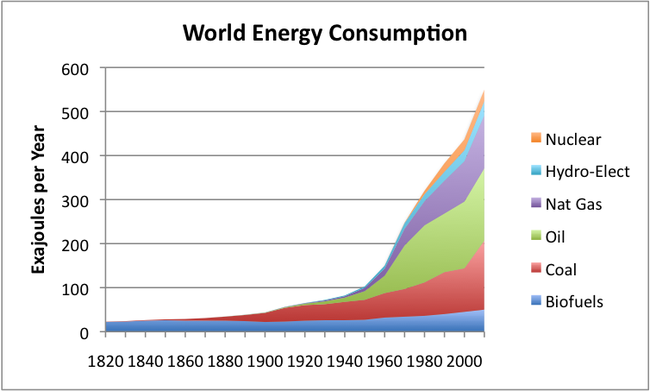 |
| Via The Oil Drum [3] |
Our energy use has exploded since the mid-20th century to the point where we use approximately five times as much energy in 2010 as in 1950. Approximately 80% of today's energy comes from fossil fuels, which have been linked with rising carbon emissions and global warming/climate change. The future, as a result, calls for another kind of change.
Renewable energy production is the ultimate goal, especially options that do not require mining or fracking, and do not release carbon into the atmosphere. According to the World Energy Council, renewable energy sources will rise from 11% of global energy sources to 16% by 2020 with a 6% decrease in dependence on fossil fuels (the other 1% comes from an increase in nuclear energy production). This shift is important for the ecological benefits, but also because fossil fuels are becoming more difficult to access and requiring more intrusive methods of access or extraction in fragile and biodiverse regions such as the arctic.
The future is at hand as many new technologies are converging to change energy production around the world from regional to local - an ever increasing concern when political issues are directly linked to energy [4]. Let's look at a few.
Petroleum alternatives
A common attempt to replace fossil fuels as a source of gasoline is ethanol derived from corn. Now considered a failed attempt, as ethanol remains more expensive than petroleum based gasoline (when comparing energy output per gallon [5]) and has an impact on global food production by tying up fields better used for other products.
In its place, several methods of replacing petroleum or creating gasoline from other substances are here or on the horizon. This is important, because our roads are made of asphalt products which are, at this point, superior in cost and performance (and comfort) to concrete roadways.
While none of these options are perfect, they will offer solutions to petroleum's two greatest issues: ecological damage from oil extraction and reducing dependence on foreign oil, especially limiting the flow of money into regions where hostile groups benefit from conflict to control oil fields. Let's look at the three best options:
Hydrogen
Long considered the holy grail of petroleum alternatives for powering vehicles, hydrogen [6] has yet to live up to the promise, as energy costs per mile remain higher than petroleum-based fuels. Valued as a clean burning fuel with water being the only byproduct, hydrogen currently requires dirty energy such as coal plants to split water into hydrogen and oxygen and then be loaded into fuel cells from which the engine draws the fuel.
Behind the projected schedule, hydrogen research continues and a recent discovery of the benefits of carbon nanotubes as a catalyst [7] for splitting water into hydrogen and oxygen without the need for platinum should bring costs down. In another move towards hydrogen as a consumer fuel, FirstElement Fuel has just announced a plan to open 19 hydrogen fueling stations in California [8] by October 2015. Many companies continue to develop fuel cell vehicles and hydrogen will gain acceptance as safety concerns over hydrogen fuel cells diminish. Once renewable energy becomes abundant, most likely through inexpensive solar panels, hydrogen fuelling could take place at home using tap water and renewable energy [9].
Algae-based biofuels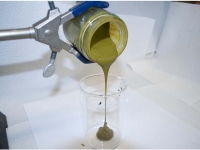 Petroleum is made from organic material processed through pressure and heat over time. Using a similar process, researchers at the U.S. Department of Energy have replicated this process to turn algae into biocrude [10].
"You start with a source of algae mixed up with water. The ideal solution is 20% algae by weight. Then you send it, continuously, down a long tube that holds the algae at 660 degrees Fahrenheit and 3,000 psi for 30 minutes while stirring it. The time in this pressure cooker breaks down the algae (or other feedstock) and reforms it into oil."
With most algae-based fuels costing up to twice as much petroleum-based fuel (at this time, petroleum prices will rise when scarcity increases an unknown number of years from now), this isn't much more promising than ethanol. Still, raising algae, or organisms such as bacteria, require less land and infrastructure than corn.
Plus, in addition to land requirements, corn involves more water, pesticide runoff, harvesting, delivery, and processing. Algae-based systems can simplify this process by including processing systems at or near the site where the algae is raised.
Algae-based fuel systems, or another process, will slowly replace petroleum-based crude over the next few decades for several reasons. They will decrease the need for petroleum extraction, provide less resource intensive processes, and as an international benefit, provide localized fuel production, cutting many nations involvement with hostile regions or countries such as Russia.
Sea-water based fuel
The US Navy has recently announced a breakthrough to convert seawater into CO2 and hydrogen, limiting their dependency on crude and cutting down on how often vessels will require refueling. While some naval vessels, such as carriers and submarines, use nuclear power as their primary source, a majority of naval fleets around the world require petroleum to operate. Sea-water based fuel production will enable longer missions by providing fuel for aircraft, smaller ships, and other needs such as landing parties.
Outside of the naval realm, this also offers other methods of fuel production around the globe. Island nations, seaside cities, and the floating cities projected in years to come could use this method to power vehicles and decrease dependency on foreign oil.
Electricity generation
Most oil is refined into liquid fuels. These fuels are used to power cars, freight haulers, airplanes, trains, heavy machinery such as bulldozers, boats and many others. This uses nearly 1/3 of all energy consumed and is responsible for smog and other forms of air pollution. Companies are now selling electric vehicles such as the Leaf, Volt, and Tesla at increasing rates, and electric airplanes are now entering the concept stage.
While this trend will help reduce local air pollution, nearly half of our energy demands are met using coal and natural gas (methane). As a result, electric vehicles aren't much cleaner than their petroleum based siblings except on a local scale with the bulk of pollution occurring near the plant.
These two energy sources are responsible for a range of environmental issues, including air and water contamination from:
- Carbon dioxide and carbon monoxide: Greenhouse gases
- Sulfur dioxide: Acid rain, respiratory issues.
- Nitrogen oxide: Smog (ground-level ozone), acid rain, respiratory issues
- Particulates such as ash, arsenic, lead, mercury, radium, and more [11]: Often connected with water quality issues, and higher level of lung cancer and other health issues.
Renewable and more efficient forms of energy creation are growing more important as climate scientists increasingly link issues such as rising global temperature averages and extreme weather to rising atmospheric carbon. While no energy source can be completely clean, there are options developing today that should make our dependency on these energy sources decrease over the next decades.
Nuclear
The Fukashima disaster serves as a reminder of Chernobyl and Three Mile Island, even causing Japan to shut down other nuclear reactors while the citizens decided the future of nuclear energy on their islands. Concerns over nuclear energy are important to consider. The risk of contamination, such as what has happened in the wake of the Fukashima flooding, and the long term issues of spent nuclear material are serious concerns [12].
 [13]While these events are alarming, it's also important to note nuclear plants have continued to enhance safety and efficiency, and to minimize waste with each generation [13]. The Chernobyl reactor, for example, was a first generation power plant. Three Mile Island and Fukushima Daiichi were both generation two plants. Newer plant technologies are safer and designed to shut down safely so risks such as a meltdown are very low.
This doesn't mean they are 100% concern free, as issues with Iran and North Korea developing nuclear plants are linked to the development of weapons grade uranium. But uranium isn't the only fuel available for nuclear plants. Thorium is now being considered as a replacement with the development of thorium-based reactors underway. A long time byproduct of mining other minerals, thorium is now being considered part of the energy solution [14]. According to a report on Reuters:
Thorium deposits, estimated to be about four times more abundant than uranium, are widely distributed: Substantial reserves have been found in China, Australia, the United States, Turkey, India, and Norway. About 6,600 metric tons (7.75.3 tons) of thorium used to power the most efficient proposed reactors would provide enough energy to replace all of the fossil fuels and nuclear energy consumed globally each year, proponents say.
Uranium-poor India has a long-term research effort under way and has decided thorium will become the mainstay of its nuclear energy industry later this century. The French government has a research program. Companies in the United States, Australia, Norway and the Czech Republic are working on reactor designs or thorium fuel technology.
As designs improve safety and a safer fuel is introduced, nuclear will continue to lose its negative reputation and replace energy plants consistently connected with human illness based on mining or burning, a need well represented by China and India's current air quality issues. Nuclear is part of our future and likely to be the only form of energy produced from a non-renewable fuel once coal is no longer necessary..
Solar
The holy grail of world energy, solar improves with each generation and is showing signs of competing with coal and other energy sources even with limited adoption. But the main issue with solar isn't cost or efficiency, it's availability. Unlike burned fuels, solar only generates when the sun is up and benefits from clear skies. As a result, solar can only impact energy use when conditions allow, requiring other sources of energy when they do not. In order to maximize solar energy, a battery can store excess energy for use at night or when there is insufficient sun light to maintain adequate power (more on this below [15]).
|
|
 CREDIT: GREENTECH MEDIA RESEARCH |
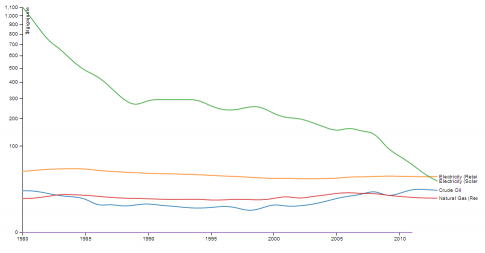
Cheap solar is already impacting energy use and costs have dropped below retail energy prices according to some reports [16]. There are a lot of politics and money involved with energy production, so numbers should be viewed with suspicion, but it is now reported that rooftop solar systems in Queensland, Australia are disrupting the cost of coal fueled energy [17]. Combined with Germany's record of nearly 75% of their energy being provided by renewable [18] energy (wind and bioenergy provided the most, but solar is on a fast rise) we are beginning to see the benefits of solar energy which should provide impetus for mass adoption of the technology.
Not only a renewable technology capturing a free energy source, solar also has few downsides. One minor issue is the amount of land required to provide enough energy for large-scale industrial sites. To maximize the sun's energy, solar panel placement is optimal in areas with a long day and no shade - exactly the kind of land farmers prefer.
To minimize land use, rooftop solar and even the sides of buildings can be used for placement. Going a step further, an Indiegogo project [19] raised $2.2 million this year to cover driveways and roads with heavy duty solar panels designed to turn the landscape into a solar array. It's a long shot this product will reach consumers [19], but the idea will exist at some point in the future. This will be especially important in regions where daylight is limited and heated roadways benefit drivers in winter conditions.
Identified as the key renewable for energy democratization [20], the ability to independently produce your own energy without reliance on retail energy, solar is the future.
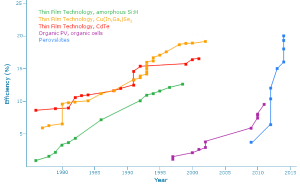 [21]Sidenote: To give you an idea of how solar outlook can quickly change, author Ramez Naam [22] shared this image on his Twitter account since I began writing this Futurepath (from this report [21]). The blue line at the far right represents the rise of perovskite (a type of mineral formed from titanium, oxygen, and calcium) efficiency in solar panels.
While it isn't a fair comparison, given what we knew about solar panel design by the 2000's, it is interesting that perovskite solar panels offer higher efficiency with less than a decade of development than the three leading competitors, all of which have been in development for 20+ years.
2nd sidenote: After reading this, my wife asked if there was a formula for identifying whether a home is capable of providing 100% of the normal energy used in that dwelling. MIT has an article answering this question [23] and the following paragraph gives some insight into how much surface area is required in two different US climates.
So let’s put some numbers to the question: Imagine that your house uses 48 kWh of electricity per day (about average). If you live in Arizona, where the average solar insolation per year is around 6 kWh/meters squared/day, you’ll need 53 square meters (574 sq ft) of 15% efficient solar panels. If you spend the extra money for 21% efficient solar panels, then you’ll only need 38 square meters (409 sq ft) of solar panels. But if you try to power the same sized house in Vermont, where the average solar insolation per year is around 4 kWh/meters squared/day, you’ll need 80 square meters (861 sq ft) of 15% efficient solar panels and 57 square meters (615 sq ft) of the 21% efficient ones.
Geothermal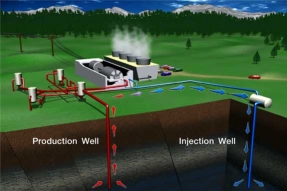 [24]Less well known than other renewables, geothermal energy [24] production requires proximity to thermal heat provided by lava near the Earth's surface - typically near tectonic plates. Water is pumped into the ground where it contacts hot rocks and turns to steam before forcing its way to the surface to push power-generating turbines.
The largest producers of geothermal energy [25] include the United States, Philippines, Indonesia, Mexico, Italy, and New Zealand. Lucky countries such as Iceland, only accounting for 5% of geothermal energy production, uses this method to meet 30% of their national energy need.
Hydropower
Water generated energy was originally used 2000 years ago by the Greeks to grind wheat into flour. Waterwheels harnessing the flow of water have been used since Roman times to power mechanical systems for a variety of purposes. After the development of the electrical generator in the late 1800's, this new system was paired with water turbines to create electricity. Since then, hydropower has branched into six different categories [26], with dams being the most visible of these formats.
Considered renewable and sustainable, traditional dams are under fire for interrupting water ecosystems [27] such as fish spawning and even causing the extinction of aquatic species. They also block sediment from reaching downstream ecosystems and lower water tables.
Traditional dams will be part of the future, though we should see less of them, and the continued removal of dams [28], as options such as solar and wind provide electricity with less impact on the environment. Less invasive hydropower options that utilize flowing rivers or use other water sources, such as water already diverted for other uses, will mature and increase in use. Traditional dams are likely to decrease in use, and some may even be removed over time, as hydro becomes less necessary through the rise of solar and wind options [29].
Tidal power
Water moves constantly and, while rivers follow gravity downhill, oceans ebb and flow with the sun and moon and the rotation of our planet. As a result, there is a great amount of untapped energy in our tides ready to be harnassed. These technologies include placing turbines in the water, capturing seawater in large reservoirs that power turbines as the tide goes out, and vents that run out under the ocean allowing tidal ebb and flow to force air through turbines to create energy.
Tidal power is promising, but also has issues. First among them is the effect of corrosive salts on machinery. Second is the ecological impact when these systems cause damage. Last is the effect moving parts and the sounds created by underwater turbines can impact water life. Tidal power will be part of the future, though best practices and improvements should minimize the negative impacts and increase the lifespan of expensive systems.
Efficiency technologies
In Abundance, the Abundance Pyramid places energy on the second tier as a necessity after food, water and shelter have been secured. Energy isn't just for air conditioning and TVs, it provides food security for individuals to maximize the edible lifespan of grown, gathered, or purchased foodstuffs. It also increases the effective lifespan of hard to acquire medicines. Light from energy provides time to share company with family, time to learn, and safety from injury.
About a decade ago, I spoke to my father in law about the future of energy. I believed at the time that solar was the future, but he, an engineer specializing in energy, felt nuclear was the future. It was his opinion that solar would be limited to fair weather days, as mentioned above. These new cost-effective batteries are examples of a technology hard to envision just ten years ago when nickel-cadmium batteries were the norm and lithium-ion had not reached mainstream adoption, much less some of the ideas presented below. One affordable, large-scale battery per home could change everything.
Let's look at new technologies whose adoption could change our infrastructure and provide more independence:
Home batteries
In Abundance, Diamandis and Kotler sum up the issues of solar with a single paragraph:
Ultimately, it doesn’t matter how cheap solar gets unless we can store that energy, and storage on this scale has never been achieved before. Grid-level storage requires colossal batteries. Today’s lithium-ion batteries are woefully inadequate. Their storage capacity would need to be improved ten- to twentyfold, and—if we really want them to be scalable—they have to be built from Earth-abundant elements. Otherwise we’re just exchanging an economy built on the importation of petroleum for one built on the importation of lithium.
Fortunately, multiple systems are being developed that promise to collect excess energy - perhaps even "filling up" during off-peak charges - to provide power when the sun isn't out and the wind isn't blowing. Several are mentioned in Abundance, the first being "flow" batteries [30] designed to offer energy dense large-scale storage. These systems are larger than what a single home might use, but could offer storage for neighborhoods or small collectives.
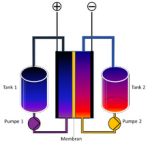 Flow batteries use two chemical components that flow as a liquid on either side of a membrane. An ion exchange occurs through the membrane, allowing energy to flow one direction when charging and reversing flow to provide energy when under demand. Among the companies working with this technology, Primus Power is mentioned in the book and has just completed a $20 million investment round to continue development.
Another technology is the sodium-ion battery [31]. These systems are being developed as an alternative to expensive and rare lithium ion batteries [32], run at room temperature, and can power devices, cars, or offer energy storage systems for homes. A paragraph in Abundance presents the technology:
Yet another option being developed are liquid metal batteries, another battery system using salt which is "sandwiched between two layers of liquid metals" and is both scalable and inexpensive - "The result is a battery with currents ten times higher than present-day high-end batteries and a simple, cheap design that prices at $250 a kilowatt-hour fully installed—less than one-tenth the cost of current lithium-ion batteries. And Sadoway’s design scales."
One of these systems, or their competitors, could provide an inexpensive, scalable, energy storage system that does not require rare and/or mined minerals. These systems would offer solutions where energy is generated and stored locally with little or no pollution.
And if there is any doubt these systems are coming to homes, maybe yours, Panasonic is now selling complete systems to Indonesia for use on their 13,000 islands [33].
Clean home generation
Another home energy solution, again mentioned in Abundance (which is part of why it's a great read and resource), is Dean Kamen's sterling engine design used in the NRG Energy Beacon 10 [34]. The Beacon 10 is a 10 kilowatt home generator designed to run off natural gas, biogas, and even to convert some household garbage to energy.
Designed to provide on-demand power, these systems are highly-efficient generators providing home power when needed and waste heat can be used to heat water or air for the home. Combined with renewables such as solar and wind, and a battery system, the Beacon could provide local energy production for homes when solar isn't producing and batteries are depleted.
Combining the technologies of solar, home batteries, and home power generation would decentralize energy production, democratizing it to homes or local groups willing to make the investment.
Other ways to produce energy
Like with other renewables, there are other ways to produce energy for homes (or businesses). Here are a few:
Power from heat transfer: A company called Alphabet Energy has discovered a new material enabling thermoelectric energy [35]. This process uses waste heat as a source of energy to create electricity as the heat transfers through the material. This technology could be used near home heat sources such as hot water tanks, near ovens, above fireplaces, and possibly in car hoods and roofs in addition to solar panels to provide extra juice for electric cars.
Sewage methane: Methane gas is considered a worse pollutant than carbon dioxide, yet we produce it from a variety of sources such as sewage and landfills where it could be used instead of released into the atmosphere. Some landfills are already using methane siphons to create energy as the trash in the landfill breaks down underground. New technologies are looking to capture methane from sewage treatment plants and, if it becomes cost effective, to create local energy using what builds up in sewage lines.
Hydro from home waste water: For a majority of homes, waste water falls to below ground level. Using a turbine in the main line, some of this gravity-fed energy can be captured.
Rooftop wind turbines: New designs are making rooftop wind energy cost effective to implement. These systems benefit from the pressure change as wind pushes over a roof and avoid the need for elevated turbines that might ruin your neighbor's view of the sky and wouldn't be allowed in some neighborhoods. While areas with ample sunlight for solar production might not use these, northern regions with more wind energy than sun energy certainly would.
Home efficiency: While creating cheap energy is an aspect of an abundant future, so is decreasing energy use. There are many ways to decrease energy requirements, including: more efficient AC and heating units, smart thermostats, better insulation, more efficient light bulbs, tankless water heaters, light colored roofing materials that deflect unwanted solar energy, and landscaping to maximize winter sun and minimize summer sun.
While none of these methods would put a huge dent in a family's energy costs (unless they get much more efficient and less expensive to implement), each does save money and dependence on central utilities. Much like regenerative braking in electric/hybrid cars, they are worth implementing in some situations even if they aren't the main source of power.
The future of power utilities
Of course, no view of the future of energy is complete without a review of our current power utilities, which will remain necessary for at least decades. While the source of our energy shifts to renewables, we will benefit from on-demand energy from central sources, and these operations are not cheap. It does cost a great amount of money to extract fuels from the ground, ship them to the plants where they are burned for energy, and then to provide that energy through the grid.
As our dependence, and purchasing from, these plants decreases, we're already seeing retail energy prices increase [36]. Dividing the cost of operation by the number of kilowatts sold should result in every higher numbers as energy dependance drops - another reason for individuals to begin shifting to solar. The Queenstown event is a great example [37] of a situation where solar has plummeted the amount of energy retailed, but those same homes and businesses may require energy at many points in the future - energy provided by the local coal or gas power plant (It should be noted the Clean Power Act [38] limits emissions to such an extent that many coal plants are already shifting to gas ahead of the law's required pollution limits).
While utilities are viewed by many as dirty, monopolistic companies (others consider them overregulated entities), they are also part of our national security. Blackouts often result in riots and increases in other crime. So keeping these systems operating should also be part of our future, even if they operate as energy producers for only a few more decades. Utilities can remain profitable by offering a few services:
1. The first is to keep offering energy as a backup. For areas where renewables remain dormant long enough to deplete batteries, utilities could offer a service fee for those who remain connected to their grid. This would allow homes to "fill up" during off-peak times with the central system controlling which homes are drawing power to avoid overwhelming a grid whose peak draw is greatly diminished.
2. The second way is to generate their own renewable energy. Investing in solar and wind farms to power dense urban areas by harvesting power from rural areas would also provide a profit. By providing incentives to customers, the utilities could also use home batteries to store excess energy to be drawn out to provide energy at night and other times when renewables aren't producing. Instead of installing a massive number of batteries of their own, they could crowd source batteries already installed in homes.
3. Another way is to act as a reseller of local energy. When a home battery reaches saturation, the remaining energy not required for ongoing home demands could be shifted into the grid at a set rate. The homeowner has the chance to sell excess energy and the utility acts as the service to manage the exchange.
Someone will need to run these exchanges. There is even some belief (and concern) that companies such as Google or Apple might get into the energy service, looking for another service to disrupt through innovation and consumer focus. If utilities remain locked in the past and fail to innovate, it's hard to say where the future takes us.
The future of energy
In many remarks in this article, I've focused on American infrastructure. But the affordability of new advancements are not necessary for the American or Canadian markets, countries that possess enough resources and money to continue as we are.
Adoption rates will skyrocket in other places around the globe. Europe is already investing heavily in new energy infrastructure. Dependant on Russia for much of their energy, mostly in the form of natural gas, Europe is in an ongoing crisis with a heavily-armed neighbor. Shifting to solar and other alternative energy sources is a political necessity.
China and India, as mentioned above, suffer some of the worst air pollution levels in the world - mostly from coal fired plants near major industrial cities. These nations are already investing in cleaner alternative fuels and energy sources as a way to change their atmospheres and cut down on the myriad health issues resulting from these levels of sustained air polution.
And then we look at remote areas in Africa, where the primary fuel is firewood. These homes do not have access to power as there is no infrastructure to support it. Solar, wind, and perhaps gas would change - and save - lives by providing enabling energy. Low-cost batteries, mostly owned by villages and underwritten by different benefactors, would change the hours between dusk and dawn forever.
While America may not need these advancements, the world at large will provide a lot of profit for companies able to produce at an affordable rate. As a result, the scale of production will bring costs so low every modern nation on the planet will have no choice but to begin the shift to cleaner, freeing energy sources. It's impossible to see exactly how our energy grid will look in 20 or even 10 years, but I've already picked out a spot for the battery and figure I have one more set of traditional shingles to put on our roof before it's covered with solar panels.
The only thing we can predict is that the sun will power our future lives as the primary source of energy, the same as it was for the millennia before we invented the steam engine and powered light bulbs.
Explicit:
- No explicit material [39]
Location:
- On Earth [42]
 Interested in the social impact of our future advancements, Daryl developed and built Regarding Tomorrow as a platform to share and discuss our collective hopes and fears of the future. Daryl's background is in education, including graduate studies in special needs and a masters in instructional technology [43] from UVA's Curry School of Education [44]. He has worked as a high school teacher and has over 10 years of university experience in the US and Canada.