Beauty (attraction)

River of Gods


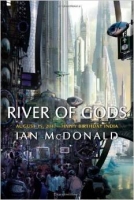
River of Gods coverIt's 2047, a hundred years after India gained independence from Britain, River of Gods is set in a country now broken into smaller nations. There hasn't been a monsoon season in years, resulting in a parched region with a Ganges trickling through Varanasi after being dammed upstream - a dam that has two nations on the edge of war.

The world is a different place in 2047. Genetic modification is everywhere, including superchildren and gender neutralizing body modifications. Artificial intelligence operates at different levels, some of them above the limits banned by international treaty. Otherwise, much of India is still poor, water is even more scarce, and the caste system carries on with only a few adjustments.

However, the Americans have found something deep in space. An object that causes a lot of questions and sends a specialist in search of her former lover. In India, someone else finds him first, someone with a strange past and who might not be completely human. Meanwhile, Mr. Nandha, one of the Krishna Cops, is hunting aeai's (artificial intelligence) with his team.

A winner of the British Science Fiction Association award and a nominee for both the Arthur C. Clarke Award and Hugo Award, River of Gods is a wild ride through a futuristic Indian culture. The complexity of the story, presenting normal human lives and emotions intertwined with decades of advancements, presents a believable backdrop against which events unfold.
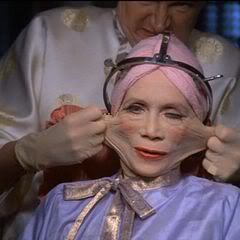
The impact of life extension

Katherine Helmond getting her face stretched in the movie BrazilPromises to extend lifespans keep rising. Some online surveys peg my lifespan between 76 and 88 years old, but specialists are claiming lifespans as long as 140 years for some humans as medicine provides the ability to regenerate, grow, or print and replace human tissue. With ongoing breakthroughs in organ printing, providing they can get bodies to accept the replacements, it is theorized the replacement of every body part with the possible exception brain can be replicated and the limitation with the brain is shifting our persona/character/self/soul into a viable replacement - an advancement that could truly create immortality.

If this turns out to be true, then science is really looking for ways to keep the brain healthy and living for a longer duration. Looking back at Bruce Sterling's novel Holy Fire, the character Mia lives by the rules governing her participation in a lifetime-enhancement program. I'm not certain longevity won't be available to the masses, or at least those who can afford the payments for procedures or insurance to cover the costs, but I do suspect Sterling got it right that longevity will be a privilege and not a right.

Love Minus Eighty

Love Minus Eighty book coverWelcome to the early 22nd century. Social media connects the elite in real time, and the digital divide has birthed a divide so complete it has manifested a near-complete physical disconnect. And while our mortality has not been conquered, reanimation has been perfected for those who can afford it. For those who can't, there is 'freezing insurance.' And for pretty, young women who can afford insurance, but not reanimation, there is a partial life in the 'bridesicle' dating service, where if you're pretty and willing enough, a one-percenter might marry you on your deathbed before taking you home as a bride-slave.

Will McIntosh's short story "Bridesicle" won both the Hugo Award and Asimov's Reader Poll in 2010, and was a finalist for the same year's Nebula Award. Love Minus Eighty is based on the short story and a brilliant dystopian look at a future that forecasts many of today's headline issues. McIntosh offers a very engaging world where the storyline shifts between High Town and the suburbs, contrasting the have's and have-not's of the world. Looking at the social changes, it feels like McIntosh did a good job of taking some of our current systems such as social media and incoming advancements such as life-expansion and autonomous systems forward in ways that are both promising and sour to current tastes.

Protect your DNA

A young John LennonJohn Lennon was gunned down 34 years ago. If still alive, he would be 74 years old. In 2011, one of Lennon's former housekeepers sold one of Lennon's teeth at an auction in England. The winning bid belonged to Dr. Michael Zuk, a Canadian dentist. Zuk is making headlines this week by admitting plans to have Lennon cloned from DNA remaining in the tooth and raising the resulting child as his own. It brings up many questions, including the morality of cloning someone famous and who owns your DNA once you pass on.

A stronger, sexier, younger body

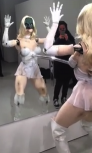
Robot stripper on screenI've been watching this video make the rounds for about two weeks. My first thought upon seeing it was, "How long before Madonna is on the phone with Kurzweil and Kaku to figure out when she can dump her brain into it and plan a new world tour?" Humorous, but hardly kind. Though I'm no fan of Madonna and believe she is narcissistic to the extreme, I also have to admit most of humanity is the same way. If we could push our minds into machines like these, how many of us would and how often?

A Woman Sold for Her Brains and Body

"And this, Mr. Trupp, is our greatest gem."

The attendant led the woman...no, girl this time...by the hand as she had the others. Warren wondered if this 'demo mode' hurt them or if they were even aware of the time passing.

As with the others, the attendant brought her into the room, told her to twirl and sat her on the sofa opposite him. Mr. Lomen reached up to caress her cheek with two fingers. The girl did not flinch or even seem to notice his presence.

Where will technology and big data take our future?

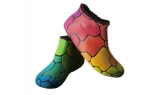
Stratasys 3d printed shoes

Technology is slowly infiltrating every area of our human existence. I read Alistair Croll's Race Alongside the Machine today on re/code and it led me to a reflection on how we humans are being changed by the technology we develop and where this might lead in the future.

When I came up with the original idea for a future-focused site, I immediately created a short list I called "aspects of human existence." I've changed them to "elements of how we live" and use them as story tags, a taxonomy vocabulary in Drupal terms, in order to help users find content. After reading Croll's piece, I decided today's exercise would be to look at the (now much longer) list and see what I can come up with for where current trends and predictions will take us as we continue to combine humans, technology and big data.

The 'True Love' Bra

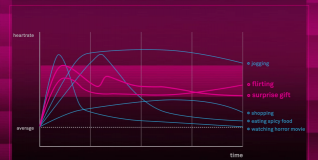
Heart rate responses to various input The Japanese lingerie manufacturer Ravijour has a new product out they call the True Love Tester bra. You can watch the video linked off the Popular Science article for their presentation of how it works, but the truly interesting detail is the graph of heart rate responses to varying stimuli - and how a company looking to market a new product uses our data.

If I understand this correctly, the bra senses the wearer's heart rate and when it "exceeds a certain value, the bra hook is unlocked automatically." A situation where a biological response can act as a trigger may be a bit part of our wearable future, but is it something we can trust or simply a gizmo to play with?

While the novelty isn't world-changing, it is an example of how our biodata can be used in different ways and how wearables can impact the world around us using our biology as a key.