Films

Surrogates (Graphic novel and 2009 film)

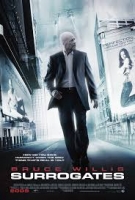
Cover of Surrogates graphic novel  Surrogates movie poster The Surrogates is a 2005 comic series that explored a future society where humans control robots from the comfort and safety of their own homes. These robots provide what appears to be perfect telepresence by connecting the owners to the outside world - without risk to their physical bodies.

The series was made into a motion picture in 2009, titled Surrogates, with a slightly altered storyline in which humans can be killed through through the Surrogate interface. In both works, investigators (police in the graphic novels and FBI agents in the film) attempt to solve a series of crimes involving attacks on surrogates, with the investigation taking them deep into societal issues between a modern world and a militant group who refuses to interact with surrogates.

They are both engaging stories exploring extreme telepresence and the positives and negatives that come with the technology. The graphic novels are thoughtful and very well written with a lot of believability. The film is science fiction as an action film, though Surrogates takes time to explore additional elements not included in the graphic novels, adding to the plot and in the background of the main storyline. It's an intelligent movie behind the gunshots and car chases.

TiMER (2010 comedy)

Timer movie posterWhile most science fiction uses action films to hide ways to make us think, TiMER is a relationship comedy. Set in a future where a wearable device counts down the time until the wearer is destined to meet his or her soul mate, this soft science fiction film looks at what we lose when we give too much control to a technology.

In the film, Oona (played by Emma Caulfield from Buffy the Vampire Slayer) has a TiMER that doesn't register a number - meaning her soul mate has not yet had a TiMER installed. The film explores the myriad ways the service influences how users seek, wait, and find love. It's an interesting film that is a nice break from the explosion filled dystopias Hollywood tends to produce.

Robocop (2014)

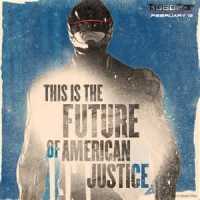
Robocop posterA future of robots replacing military and police personnel is just a matter of time. The new Robocop, a remake of the 1987 cult classic, bases the need for a cyborg police officer after mass refusal of robotic policing of US citizenry. To put a human face on the next age of police service, detective Alex Murphy is used to operate a new body that makes him a cyborg supercop and his success will provide acceptance for OmniCorp to begin selling robots to police all over America.

As part of the Robocop system Alex influences, but doesn't always control, the police software or the body it operates. The film explores his posthumanity and the line where the human ends and the robot begins - or the other way around. Seen as the Future of American Justice, Alex/Robocop works through issues at a personal level while acting as the star of the Detroit police department and a pawn of OmniCorp's need for new contracts.

Her (2013)

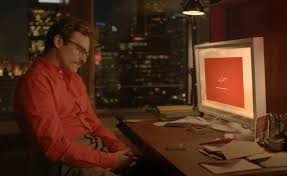
Her - setting up the computerTheodore Twombly is an introvert going through divorce. After he purchases an operating system designed to be a virtual friend, Theodore become emotionally attached to 'Samantha' and enters into a romantic relationship with her. - her being the artificial intelligence in his computer. Her follows their relationship through the typical trials most human relationships go through, with the added issues of a virtual companion who attempts to satisfy their 'lover' through a variety of emotional and romantic experiences.

At its heart, Her is a relationship film set around two very different people, one made of code, attempting to find common ground. It explores the variety of their relationship from Theodore's viewpoint, though Samantha's growth and issues are also represented throughout the story. As the story unfolds and the relationship goes through its ups and downs, we get a sense of this new and fragile pairing.

Nominated for five Academy Awards, Her won best screenplay in addition to being nominated for best picture. With a laid back, futuristic setting and a story presented through conversation and emotion, Her isn't just science fiction, it's a brilliant look at a future where artificial intelligence, and also artificial emotion, impacts the individual.

I, Robot (2004)

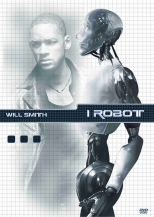
I Robot movie posterBased on the Asimov short story collection of the same name, I, Robot explores a society where humanoid robots are everywhere, doing a range of jobs, through a detective who is distrustful of robots due to a tragic accident he survived, but others didn't. As a result, when a murder happens and a robot could be responsible, the detective has to overcome doubt that a robot, required to follow the Three Laws of Robotics, could kill a human.

Another action science fiction film based on Asimov's work, the film is set in a future with many many societal changes, yet still feels incomplete. The movie is almost too clean, another clean utopia containing devoid of nature (except the cat, gotta save the cat). Yet the benefit of that sanitized environment is the way the crime stands out. Everything looks so clean and feels so efficient, you have to wonder whether any crime happens at all. For that reason, the CGI worldbuilding works for the film, though I have to wonder if a future remake with grittier writing and scenes might offer a more believable setting.

Rise of the Planet of the Apes (2011)

Rise of the Planet of the Apes posterThe original "Planet of the Apes" introduced us to a world where humans are secondary to our closest family species in the great apes. The film relaunch of "Planet of the Apes" set those events in our future. "Rise of the Planet of the Apes" explains why these species are uplifted to human-level intelligence and the resulting conflict when humans attempt to deal with "alien" emotions, attitudes, and actions.

The film focuses on the development of an uplifted chimpanzee named Caeser, who gains human-level (or greater) intelligence as a result of the pharmaceutical testing of a potential Alzheimer's cure on his pregnant mother. Raised by the scientist who developed the cure, the film presents Caeser's life from a newborn to his role as a leader of a group of uplifted animals.

Minority Report (2002)

Film posterBased on "The Minority Report," a short story by Philip K. Dick, this film explores the issue of preventing crime before it occurs. The PreCrime division, a special unit set in Washington, D.C., uses three individuals who possess the ability to foresee murders before they occur. When each case is identified, including the victim, the perpetrator, and the time, the PreCrime police use recorded visuals from the "precog's" visions to identify the location and foil the crime before it happens.

While the division has had great success and is considered perfect, the film focuses on what happens if these visions are not 100% reliable. Especially when the perpetrators are arrested and imprisoned when they were not allowed to actually commit the crime.

Blade Runner (1982)

Considered one of cinema's most influential science fiction films, the Blade Runner screenplay was based on Philip K. Dick's novel Do Androids Dream of Electric Sheep? and directed by Ridley Scott, who also directed sci fi classics Alien and Prometheus. Blade Runner is set in our near future, 2019 is only 5 years away, against a dystopian backdrop of a filthy, crowded, culturally mixed cityscape on a planet where most humans appear to have left for other colonies. As with most classics that visualized technological and ecological hell on the other side of the year 2000, the vision is not accurate. Yet, it navigates issues we are discussing today because they will be here tomorrow.

The Island (2005)

The Island dvd coverClones are big business in the future. Buy your own to supply the parts you require when sickness or injury threaten your life. The Island is a sci-fi action adventure set in the not-too-distant future, told from the viewpoint of two clones as they discover the truth of their existence and work to uncover corporate inhumanity.

Lincoln Six Echo and Jordan Two Delta are clones living in a safe, controlled world among others of their kind. History tells the outside world is too contaminated for life outside the compound, with only one remaining island clean enough to support human life. The clones live their routine hoping to one day win the lottery and move to the island, where they can live out their lives under the sun. But it's all a lie fabricated to keep them controlled and hopeful, two things necessary for the products, their bodies, to remain healthy.

Gravity (2013 film)

Gravity scene grabGravity is a highly detailed action thriller set in Earth's orbit. Starting with a what should be a routine Hubble Space Telescope repair, the mission ends as events threaten the shuttle and astronauts. The movie spins the lead characters, of which there are two, through a series of attempts to survive in orbit while seeking a way back to Earth.

Splice (2009)

View of the spliced creatureAs genetic engineering progresses, humanity will be faced with issues of morality time and time again. Splice looks at the field of artificial life and the specific issue of combining human and non-human DNA. In the film, two researchers, facing the loss of their research, decide to combine human and animal DNA to create a new life form - just to prove it can be done. Once the birth occurs, each has a different response to the creature and those responses change over time as Dren develops towards adulthood.

The plot focuses on the different relationships Clive and Elsa have to the being they have birthed for science. Fearing their employer's response, they hide Dren and eventually mover her off site to protect her. Dren's development affects both scientists in different ways, with each responding to Dren and each other in different and sometimes horrific ways.


The Machine - 2013 film

The Machine

A true sci-fi thriller, The Machine presents a future where artificial intelligence is closing in on human-level capabilities and governments race to develop human-like robotic soldiers. After a cold war with China has caused a severe economic depression in the West, research into artificial intelligence is viewed as THE research to win what is considered an unavoidable war. The desired outcome is a superior soldier capable of managing a "three-block war: the battle, the negotiations, and the peace."

While too many recent science fiction films have focused on famous actors and fast scenes, adding layers of action to cross genres, The Machine is a true sci-fi film (there is action, but most of the movie is slow and moody as developments take time). Both dark and gritty, it feels like a better view of the future than the ultra-political Elysium or any film dealing with human-alien strife. Swinging for the fence, Caradog James, writer and director of The Machine, bangs one out of the park.

The Bourne Legacy

Bourne Legacy cover

Sometimes a great look at the future shows up in places you weren't looking. The Bourne Legacy, the sequel to the trilogy with Jeremy Renner (Hawkeye in the Avengers) taking the lead role, is a fast-paced look at posthumanism and one of the better futurist films I've watched in some time.

I'd mostly ignored Legacy, figuring it would eventually hit Netflix, but found it in the library on Blu-ray this week and picked it up. Finding some free time today, I started watching and was blown away as the back story came together piece by piece. Sometimes the best views of the future arrive in a medium other than science fiction.

Stop here if you don't want to read spoilers. But this is a great movie and worth checking out.

Elysium (Film, 2013)

A look at the living area of ElysiumSet in 2154 (140 years from now), the wealthy have fled an ecologically devastated Earth for the space station Elysium where they live what appears to be a an idyllic life in a pseudo-suburban setting filled with clean air, beautiful vistas, and luxurious homes stocked with miracle health machines.

Extremis - Iron Man becomes posthuman

ExtremisWarren Ellis introduced the Extremis concept to Iron man in a 6-issue story arc starting in January 2005. This arc changed Tony Stark from a cyborg to a posthuman by introducing nanotechnology into his body and altering his physiology to include direct connections with the Iron Man suit. Ellis introduced many concepts and characters that were used in the Iron Man movie trilogy, especially Iron Man 3.

If you're into superhero comics, this is a short arc you don't want to miss. It's available on Marvel Unlimited or through Amazon. In typical comic-book style, it takes some complex scientific breakthroughs and turn them into a magical elixir, yet it brings many of the reasons we research posthuman adaptation into perspective given Stark's need to deal with the story villains. And there are a few great conversations in which characters wax philosophical about their Frankensteinian need to create a future that might be more monster than they would like.