In Earth's solar system

Hershey supporting 3D systems to print confections

Chocolate heart3D Systems previously announced products to print your own food. This week, The Hershey Company announced a multi-year partnership with the device maker to develop new ways of bringing 3D printed foodstuffs to market. Hershey is the first major food company to officially announce an interest in 3D printed foods.

Via The Verge


The future of privacy: the necessary data or a march towards a future of corporatocracy?

Prism logoThe combination of governmental and corporate data tracking are enabling outside entities to track increasingly granular details about our lives and interactions. Most of the reasons offer positives and are focused on protecting citizens or providing services we find useful. In order to do these jobs more efficiently, inroads to more data are critical in order to query across enough channels to create accurate connections such as identifying a terrorist organization's leader or helping us make certain we get enough exercise per day.

Changes towards equality creating a better future

Our march into tomorrow keeps making for better todays. Here are vidoes of three important technologies providing individuals with physical limitations the opportunity to experience and interact with the world around them.

What is Tek RMD - 9:26 long - from Matia Robotics

Read the full article for additional videos.

Increasingly inexpensive telepresence aims at the home

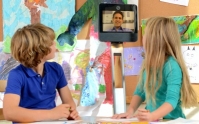
Beam+ telepresence device with two childrenSuitable Technologies has announced a telepresence robot, the Beam+, for just under $2000 (pre-order for $995). The device offers a 10-inch screen using two cameras and 4 microphones for video teleconferencing, which is build onto a stalk and moved about by a three wheeled based controlled by the "visitor" through an application on the their end.


Simple and useful wearable: Spidey sense shirt

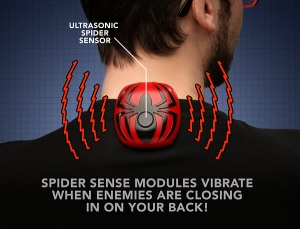
Spider Man spider-sense shirtThis year's CES was filled with new wearable technologies looking for the next big thing, but Thinkgeek is selling a tongue-in-cheek wearable as a spidey-sense shirt that vibrates when someone approaches from behind, signaling the wearer a person is within 5 feet.

The device is a novelty, announced just before last year's Comic-Con, but would make great sense as a real wearable or a feature included in a line of self-protection wearables. So much discussion on the benefit of wearables has focused inwards so far. Step tracking or distance measuring was the first real attempt. Tracking body data such as heart rate, blood pressure, blood sugar and such for biorhythm projection is where the current cycle is focused. How long before we focus outward?

Using beacons to more effectively remind or market to shoppers

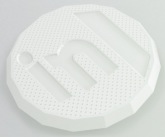
InMarket Beacon

Back at Apple's 2013 event, they mentioned iBeacon as part of their new upgrades. This technology uses Bluetooth Low Energy to alert your phone when it comes within range of a beacon - a small, low-powered device used to identify a place. Sneaky Apple not only announced a major competitor to NFC (Near Field Communiction), they also announced that some of their products (and others) have built in beacon functionality and have had them for some time. With the rollout of iOS 7 and OS X 10.9, there are suddenly tens of millions of iBeacon ready devices which can both seek or offer location awareness.

Why is this important? Bluetooth low energy technology currently offers a range of 50 meters/160 feet using a trickle of energy (less than 15 milliamps according to this page). Your phone is suddenly able to identify interesting or even necessary locations within that range with very little impact on the device itself. This is a major step towards the Internet of Things and, as with most leaps forward, will have both positive and negative impacts on our lives and privacy.

Childlike learning at any age

Takai Hensch, a Harvard professor of molecular and cellular biology, is researching valproic acid* to enhance learning. VPA is used to treat several conditions (see below*), but Hensch is researching the chemical's ability to provide adult brains with the plasticity children experience when it comes to learning new skills and to absorb new information.

In his research (via PubMed.gov), Hensch is focused on teaching adults perfect pitch. But the applications could enable learning in nearly any field. The expectation is an increase in how well adults can take in information in order to speed their learning of new material. When you consider how long it takes to master some specialties, this could help learners increase the speed through which they can cover material and provide extra years of work at higher levels. It would be a major breakthrough for increasing the efficiency of preparing humans for nearly all types of work.

The human face in 100,000 years and why it might change

Faces of our futureMother Nature Network has an article on speculative work by artist Nickolay Lamm and computational genomics expert Dr. Alan Kwan. They started with the question: “What do you think the human face might look like in 100,000 years and why?” and offered their view of how mankind MIGHT adapt over that time.

A Robotic Petting Zoo

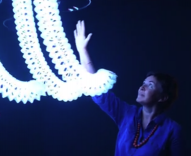
Image of robotic petting zooMinimaforms presented Petting Zoo, an interactive display designed to respond to human touch and movement. Using a Kinect camera and software designed to respond with emotions, the exhibition provided three "pets" with three different patterns of responses and a basic machine learning allows each to develop behaviors based on input from the situation.

Pages