Futurepath: Human employment
 Printer-friendly version
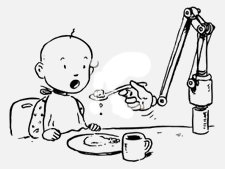 Last year, Carl Benedikt Frey and Michael Osborne published their paper, "The Future of Unemployment: How Susceptible are Jobs to Computerisation?" In their research, they identified that nearly half of US jobs will be automated within the next 10-20 years. Since then, there is a rising sense of urgency represented by the range of articles presenting the medium to long-term career forecasting of either a world of high unemployment or a world in which robotic productivity creates a socialist scenario where all humans maintain a minimal life quality without concern over unemployment. Digging more deeply into viewpoints with more diverse data and historical comparisons show a lot more reasons to be either bullish or bearish on the future.
Let's look at some of the ideas being presented:
When does a technology take over a career?
When the cost of human labor is higher than the cost to automate, there is the chance of disruption. Robots and computers are able to do their work 24 hours a day, year round, with down time only for technical issues and being serviced.
Developing the technologies required to replace a human is an expensive task. Many startups have gone bankrupt trying to develop an alternative worker, as have companies attempting to integrate new technologies into their existing systems.
Given how quickly the cost of engineering a system can decrease, the curve of job-replicating technologies is, or is about to, explode. While every forecaster seems to believe this trend will continue or speed up, let's also recall the fear India would take over the IT world with every company outsourcing both development and support to inexpensive, well-educated English-speaking workers on the other side of the Pacific. While India has benefited in many ways, many US companies found themselves reversing that decision as not every situation proved beneficial to either the company or the customer. The same could happen with robotics as companies rush to replace frail, error prone humans only to discover removing human workers from the production line has a negative impact on their bottom line.
Current trends
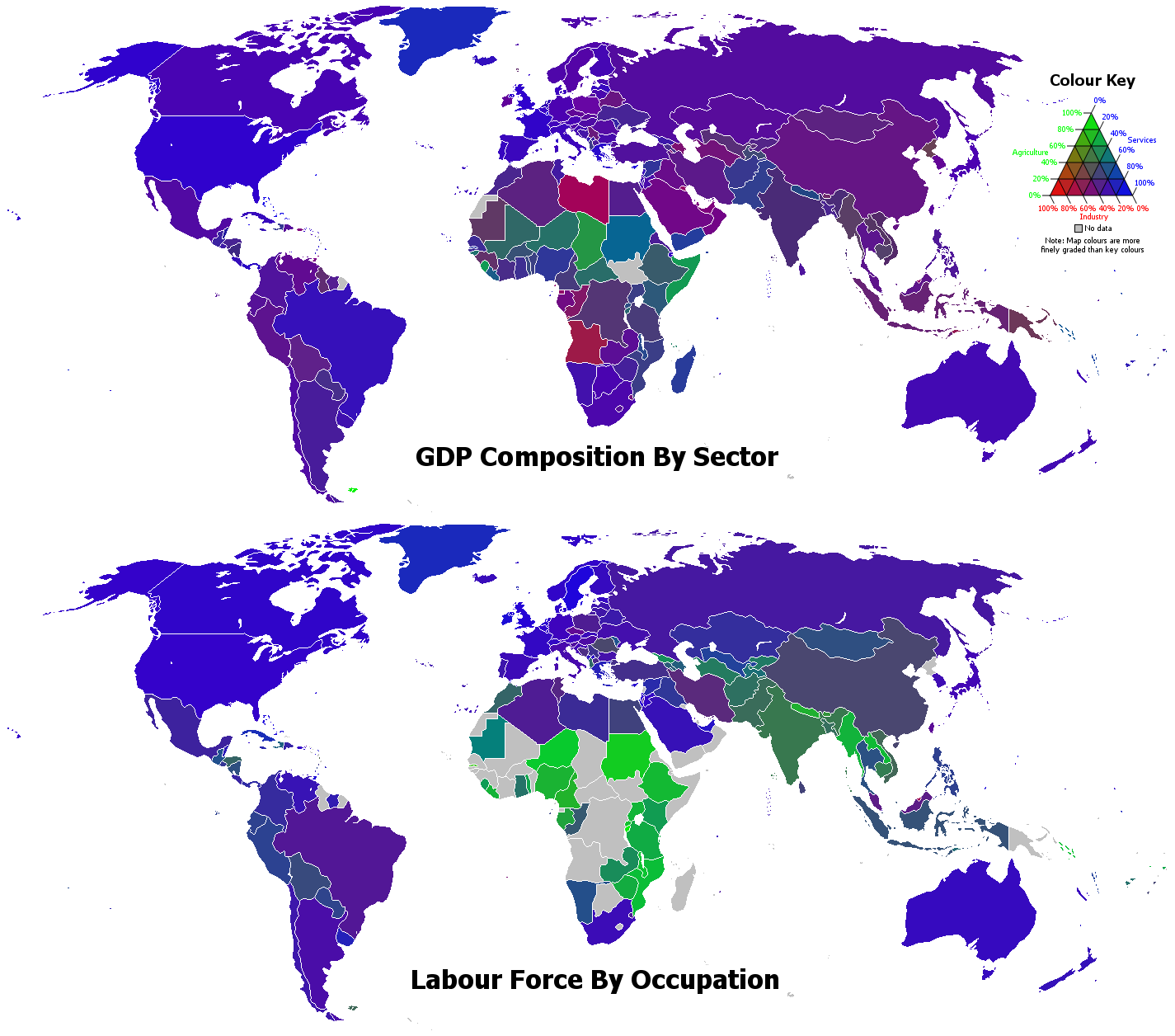
Let's begin by understanding which parts of the world are likely to be impacted by the development of these technologies. The United States, Canada, Western Europe, and Japan maintain fairly high wages. This is part of why manufacturing has shifted to developing markets capable of providing cheap, educated labor and regional stability. China and India are both attractive manufacturing markets for these reasons. In the rest of the world, relatively high unemployment rates will keep humans employed for some time.
See this graph presenting labor force by occupation for a world view.
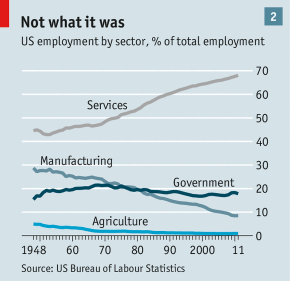 In the US, as a good example of ongoing change, employment has already been shifting over the last 50+ years. Agriculture, once the mainstay of our economy, is a miniscule portion of employment (around 2%). Manufacturing employment, based on the points I made in the previous paragraph, has reduced to less than a third of what is was in 1948. The government as an employer is slightly up since that date, but trending downward as well. Only the service industries have continued a shift upwards, growing to 7 out of every 10 employees in the US. We should keep in mind services is a wide category. Where agriculture and manufacturing are easy to identify, services is everything else. Cloud companies are a service, as is my dentist. Massage therapists, head hunters, college and universities, and retailers are all services. I find it interesting that none of the articles I've read have complained about a growing service economy, an issue I've heard a sign of economic doom since I was a teenager. Connected with a loss of creative positions, the offset for less manufacturing has been an increase in the exporting of intellectual property - a direct benefit of a highly educated worker base in a developed country. |
Characteristics of jobs that may disappear
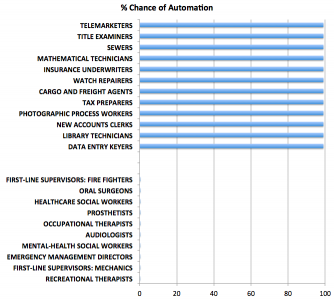
On the topic of what jobs are most likely to be replaced, Derek Thompson at The Atlantic gives us this statement:
"They are mostly routine-based jobs (telemarketing, sewing) and work that can be solved by smart algorithms (tax preparation, data entry keyers, and insurance underwriters)."
The characteristics of jobs easily replaced by machines, through either software, robotics or both, include:
- Routine
- Standardized
- Scriptable
- The outcome should be predictable
- Consistent outcomes
- Outcome can be processed by algorithms
While humans can be these things, our humanity also makes us distractable, prone to fatigue, emotional, and inconsistent.
Characteristics of jobs that are expected to remain or grow
Historically, the most successful individuals during a time of change are the most adaptable. According to John Shinal for USA Today:
Workers wanting secure employment in coming decades will need skills that complement software applications, rather than compete with them.
It falls into a "If you can't beat 'em, join 'em" view, but software has been infiltrating our work days since the invention of the personal computer. which has multiplied worker productivity many times over. Today, smartphones are providing mobile computing and wearables will offer a range of benefits we are only starting to experience.
Back to Thompson at The Atlantic and his chart, "At the bottom, I've also listed the dozen jobs they consider least likely to be automated. Health care workers, people entrusted with our safety, and management positions dominate the list."
At first glance, this reads as:
- Empathy
- Oversight
- Management.
If we look deeper, we can add in the qualities:
- Adaptability
- Creativity
- Decision making
- Flexibility
- Responsibility
- A human awareness of human needs
When we put them together, I believe we can see a bit of the future. More on that at the end.
Rising tides and lower wages
As mentioned above, one of the arguments over what the future holds is a fear of massive unemployment versus a socialist scenario where individual wealth rises to the point where their basic needs are met without a need for regular, full-time employment. I've covered this previously and it should be a major concern.
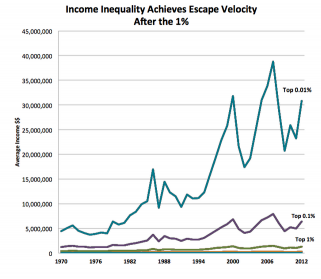 I'm not certain what additional content needs to be considered on how this might play out, but in another article Derek Thompson points out the top 0.01% is the fastest rising group, leaving the remaining 99.99% flat or falling. While it probably isn't enough to translate into a definitive forecast, this seems to support rising unemployment and falling average wealth.
The future has yet to play out, but automation in the hands of the top tier could also mean we humans are no longer necessary, except as consumers as basic economics require both supply and demand. Until robots consume, humans will still be the driving force behind the world economy.
Limitations of robotic job destruction
Some believe the engineering of both hardware and software will plateau, waiting for artificial intelligence. Without a true AI, there are limitations to what machines can do as replacements for humans. In an article by John Markoff for the New York Times, we get:
"...Bran Ferren, a veteran roboticist and industrial product designer at Applied Minds in Glendale, Calif., argues that there are still steep obstacles that have made the dream of the universal assembly robot elusive. “I had an early naïveté about universal robots that could just do anything,” he said. “You have to have people around anyway. And people are pretty good at figuring out, how do I wiggle the radiator in or slip the hose on? And these things are still hard for robots to do.”
So another benefit humans have are the range of abilities evolution has provided.
- Dexterity
- Problem solving
- Adaptability
- Personality
- Empathy/sympathy
- Nuance
In an article from The Economist, we get this view:
These jobs may look distinctly different from those they replace. Just as past mechanisation freed, or forced, workers into jobs requiring more cognitive dexterity, leaps in machine intelligence could create space for people to specialise in more emotive occupations, as yet unsuited to machines: a world of artists and therapists, love counsellors and yoga instructors.
This makes me believe we are generations away from replacing some job types, if we ever can. Will machines become emotional? Not a faux emotive copy designed to fool humans into believing they care deeply, but true emotional bonding? I do not believe I will see this in my lifetime and doubt it will ever happen. Programming a machine to "need" their owner is not the same thing as the human compassion we are capable of feeling for others.
Social impacts
It's difficult to forecast the future. Change can happen quickly and have an unforeseen influence on the world around us. As middle tier positions in manufacturing have been automated, the need for low and high skill positions have grown. Automated systems will require both maintenance and human creativity to progress.
Working in higher education, I have heard first hand from faculty filling non-tenure positions of the near impossibility of earning a tenure-track position. "Once you accept that non-tenure position, you're never seen as a researcher no matter how much research you publish," is a statement I've heard more than once about the Ivory Tower. If there exists a near-impenetrable gulf between two jobs that appear nearly identical to most people, what might happen with a divide between low-skill and high-skill positions in a society that doesn't offer many bridge roles? The glass ceiling gets very low for nearly everyone in the low-skill positions.
Suddenly, we're in Brave New World with two tiers and little traffic between them. According to research from the Pew Economic Mobility Project, Americans currently live in a system where very few individuals born in either the top or bottom fifth's of American income shift more than one rung from generation to generation. If the American Dream has been replaced by economic caste-ism, what might the future offer?
The Silver Lining
Two of today's fastest growing job areas are medical and education. Medical can be linked directly to an aging population, one in need of consistent care. Education represents the competitive nature of employment as formal training and diplomas represent awareness and knowledge, plus a proven record working within a system. If these trends survive automation, what might we have? A more educated citizenry more capable of caring for each other sounds pretty good.
In "The onrushing wave", The Economist provides historical viewpoints (A very thorough article):
Previous technological innovation has always delivered more long-run employment, not less.
If this is true, maybe we find better work-life balance. Supply goes up, using less man hours and resources. The average work week drops to 30 and then 25 hours, diminishing with each generation. If that's the case, machines are welcome to our jobs if we're still able to function as a society and provide for our children.
Conclusion
Looking at our own history, it's tempting to to anthromorporphise machines as the next alpha-predator. It's easy to suspect an intent to take our jobs and eventually jettison us from our home planet. As I stated above, our economy is driven by demand. Robots and their owners meet this demand, being paid for the products and services they will provide to the economy, an economy that, without human need, can't exist. Humans will need an income and our politics will require everyone to at least attempt to earn their keep.
That doesn't mean the economy won't change. Even if the 1%ers own 90% of the wealth, prices will still be based on the wealth and demand of the 99%. After all, the Veyron is a million dollar car and only afforded by the world's wealthiest. Worry as we might about income disparity, the price of the Veyron doesn't directly influence the cost of a Honda Accord and while both have an engine, steering wheel, and seats, they aren't competitors in the market.
So while I will be watching trends to help my daughter make sound decisions for her future, I also expect her to work regularly throughout her lifespan. If she becomes a lifelong learner like myself, I believe she will always find success. And if she remains kind-hearted and sympathetic towards others, she may excel where others cannot.
More Articles on the subject
Skilled Work, Without the Worker - The New York Times
How many jobs are most endangered by new technology and changing economies? - Next Big Future
Here’s How to Keep the Robots From Stealing Our Jobs - Wired
Is 2014 the year YOUR job will be taken by a robot? 'Jobocalpyse' set to strike as droids are trained to flip burgers, pour drinks - and even look after our children - Daily Mail UK
What Jobs Will the Robots Take? - The Atlantic
Future economy: Many will lose jobs to computers - USA Today
Want a job? Deliver, or protect - CNN
The onrushing wave - The Economist
Will we have a future of extreme inequality and bountiful resources? - Regarding Tomorrow
Economic Mobility Project - Pew States
Productivity improving technologies (historical) - Wikipedia
Disruptive innovation - Wikipedia
Explicit:
Location:
 Interested in the social impact of our future advancements, Daryl developed and built Regarding Tomorrow as a platform to share and discuss our collective hopes and fears of the future. Daryl's background is in education, including graduate studies in special needs and a masters in instructional technology from UVA's Curry School of Education. He has worked as a high school teacher and has over 10 years of university experience in the US and Canada.