Videos

A future of augmented reality for tourism and education

Augmented reality with virtual bear on a handI love history, though I struggle to internalize it without context. I find it challenging to put all those dates and names and places together without a narrative or visual aid. Travelling Europe has helped, especially when I read topical history books before and during the trip, aware of past events and visiting the sites where they occurred. Not everyone can afford the expenses or time to travel, but advancements such as augmented reality may be ready to offer some help.

Augmented reality overlays computer generated images over realtime visuals. The field was limited for mobile use until smartphones with cameras were able to provide a realtime view for a graphical overlay. Phone screens are nice, but limited. Several technologies are coming together to provide data overlays to provide rich environments, including wearable glasses (Google Glass), interactive street views (Google Stretview), and metadata tying content to a space based on both GPS coordinates and date identification. Not the current date, but the time frame the media represents.

Is this accurate of our past and, if so, should it define our future?

Man on trash mountainMan by Steve Cutts is a visceral animation depicting the history of mankind...ahem...bleeding into a possible view of our future. He focuses on our destructive nature, highlighting choices we've made some find cruel and wasteful and leading towards a demise by...well, you can see the ending yourself. Just 3:35 and worth the time.

On course to collapse or a future of abundance?

Deserted farmNews this week from a NASA sponsored study on the possibility of civilization collapse and how it might happen. The study was led by applied mathematician Safa Motesharrei and looked at five factors leading to historical collapses of past civilizations such as the Roman empire: population, climate, water, agriculture, and energy.

World Science U provides online science education

World Science U course blocksWhen I was younger, science seemed to be something far away. While we were surrounded by the products of science, we rarely witnessed the creation event of life changing technology or advancement. With the Internet, we see products months or even years before they arrive and can often access media detailing how they were invented, designed and manufactured.

Will our future include bread runs to feed our smart-toasters?

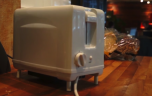
Brad the ToasterIt'll start out that way, of course. We'll buy these networked, AI driven toasters to pop some bread in which they'll char to perfection every time. There will be toast contests with our friends, an app keeping track of how many slices we consume over time and how many steps it takes to burn the calories - more with butter - even more with jam.

Like most things, the toaster will lose its newness. The shine will wear off as the dust collects. Every so often, it'll let us know how unhappy it is. How unused if feels. That's when we start buying bread just to give it something to do, so it will feign happiness and not annoy us with its app notifications - "It's time for some toast!"

If I get a robot, it better be funny

 Keep calm and bite my shiny metal ass Hey, marketers. Want me to buy a robot to help around the house? Make it funny. Make it personal. Make it raise my spirits. I can wash my own dishes and mop my own floors. I can get my own mail and cookies (and if I get my cookies, I get how many I want and not how many some @#&%@%$ app says I can eat). Yes, robots can simplify my life by managing regular chores. But can it lift my spirits in real-time?

I can't tell myself jokes or chat with myself about the news. And I'm a bit snarky on a good day - really snarky on a bad day. Of all the robots I could hang with, barring the ScarJoBot my wife will never agree to, Bender would be a hoot (and earned the top spot on this list of funny robots).

Will specialized artificial intelligence be kickstarted from a learning perspective?

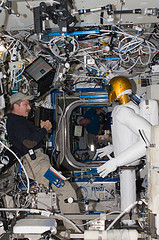
RobonautMany highly intelligent humans predict highly intelligent robots as soon as researchers find the programming and/or hardware to make it work. Theories about the technological singularity, the point at which artificial intelligence surpasses human intelligence, are supported by notable figures such as Ray Kurzweil and Vernor Vinge. It's a very attractive advancement, one in which intelligent systems can help move humanity forward faster than we ourselves are capable of managing. Coupling artificial intelligence with robotics would provide devices capable of not only responding to human need, but identifying human need in real time or even in advance of the need - and not only based on human trends, but on the needs of an individual human.

As an aside, we should also note the Terminator series turns artificial intelligence into Skynet and nearly indestructible robots with time travel capabilities. A far cry from helpful butler-bots, life-saving surgical-bots, and wiggly sex-bots.

How will we practice our faith in space?

Kelsey Atherton at Popular Science reports on the response a group of Islamic leaders had about the Mars One colony and their fatwa against making this trip as it is perceived as suicide. Robert Lamb at HowStuffWorks gives a quick overview of how religious leaders have viewed praying in space and how future advancements might impact our religions or create new ones. Part of his presentation explains how prior rulings from Islamic leaders have approved prayer away from Earth.

While much science fiction trends towards either flight from religious dominance or humanity shedding religion through social evolution, the reality is religion and spirituality will remain part of human cultures and evolve over time.

Will we allow automated robotic law enforcement?

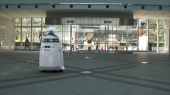
Knightscope K5 unit at a mallAutomated law enforcement would offer a network of systems capable of identifying a crime and gathering enough information on the law-breaker for human officers to identify and consider charges. This is a hot topic issue that will become hotter as technologies merge towards the point where companies will attempt to retail robotic systems to augment human police forces.

Pages