Weather (the elements)

An Hour with Will McIntosh

http://www.amazon.com/gp/product/159780276X/ref=as_li_tl?ie=UTF8&camp=1789&creative=390957&creativeASIN=159780276X&linkCode=as2&tag=regardtomor07-20&linkId=HTYCIYXBI2SHEYDAIf you aren't familiar with Will McIntosh, he isn't surprised.  Like many authors, Will is happy just to have a writing career and thankful for the opportunities his readers provide, even if his name isn't well known. But given the quality of his previous work and a new young adult science fiction series in development (The first novel, Burning Midnight, is scheduled for 2016), don't be surprised if you start hearing his name more often.

But you should know his short story "Bridesicle" won the Hugo Award for Best Short Story and also the Asimov's Reader Poll in 2010. It was also a finalist for the Nebula Award for Best Short Story that same year. His short version of "Soft Apocalypse" was a finalist in 2005 for both the British Science Fiction and British Fantasy Awards.

Soft Apocalypse

Soft Apocalypse book coverAs atmospheric carbon rises towards 450 units per million and the pitch of climatologists reach higher levels of alarm, Soft Apocalypse offers a worst-case scenario of what a slow collapse of society might look like from the inside. Where McIntosh's Bridesicle/Love Minus 80 revolved around a misuse of life-saving technology, Soft Apocalypse is an avalanche of Hell unleashed on our planet. It is futurehorror without a Freddy or Michael, where the bad guys numbered in billions around the globe. Many of them bad guys who live among us today, but who haven't been forced to show their true natures as long as the distractions of civilization keep them in check.

This story could easily be the world outside as everything unraveled in Cormac McCarthy's The Road. Watching the slow collapse of society through Jasper's narrative, we see humanity returning to its fierce roots as the veneer of civilization is slowly stripped away. Soft Apocalypse is a message you live through as you read it.

River of Gods


River of Gods coverIt's 2047, a hundred years after India gained independence from Britain, River of Gods is set in a country now broken into smaller nations. There hasn't been a monsoon season in years, resulting in a parched region with a Ganges trickling through Varanasi after being dammed upstream - a dam that has two nations on the edge of war.

The world is a different place in 2047. Genetic modification is everywhere, including superchildren and gender neutralizing body modifications. Artificial intelligence operates at different levels, some of them above the limits banned by international treaty. Otherwise, much of India is still poor, water is even more scarce, and the caste system carries on with only a few adjustments.

However, the Americans have found something deep in space. An object that causes a lot of questions and sends a specialist in search of her former lover. In India, someone else finds him first, someone with a strange past and who might not be completely human. Meanwhile, Mr. Nandha, one of the Krishna Cops, is hunting aeai's (artificial intelligence) with his team.

A winner of the British Science Fiction Association award and a nominee for both the Arthur C. Clarke Award and Hugo Award, River of Gods is a wild ride through a futuristic Indian culture. The complexity of the story, presenting normal human lives and emotions intertwined with decades of advancements, presents a believable backdrop against which events unfold.
Abundance: The Future Is Better Than You Think

Book coverIn Abundance, Peter Diamandis and Steven Kotler present trends taking us towards a better future - one in which individual needs are met on a global scale. Using Maslow's Hierarchy of Needs as a foundation, they explore technology will find ways to improve efficiency by fostering cooperation, providing access to clean water, producing enough food for a planet of nine billion, and even enabling equality as limitations dissipate.

Many projections offer a future half empty. Here, we get a lesson on how our biases enable close tracking of negative trends, whether serious, global issues or personal issues threatening a comfortable ideal we would not wish to give up. Yet, data show the world is improving. As an example, Bill Gates' annual letter from this past January presents how effective support of poor economies is stabilizing population, improving health, and helping develop economies capable of supporting human rights and freedom.

The point of Abundance is that we can both thrive as a race, free of draconian measures to tame our needs, and solve our problems going forward, using new methods and technologies to empower humanity. Why settle for half empty or half full, when the future can be filled to the brim?

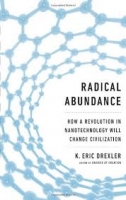
Radical Abundance: How a Revolution in Nanotechnology Will Change Civilization

Book coverEric Drexler introduced the world to nanotechnology in his first book, Engines of Creation: The Coming Era of Nanotechnology. In his newest book, Radical Abundance, Drexler presents a range of information, informing the reader of the process of nanoscale manufacturing, current efforts and research (and hurdles), and the benefits to science, society, and the planet once we achieve the reality of nanoscale fabrication.

Drexler presents APM (atomically-precise manufacturing) as the next revolution, the first three being agriculture, industrial, and information. This revolution will be powered once we control "the molecular machinery of life (using) proteins that can fit together to form motors, sensors, structural frameworks, and catalytic devices..." By using natural systems to construct from the atomic level towards larger and more complex products, we can manufacture efficiently, using common chemical substances in place of minerals and metals acquired through ecologically damaging mining, and to create materials we cannot visualize today.

In Drexler's future, APM solves many of the societal issues that create poverty, ecological disasters, and conflict. It's an important work that gives us a future to look forward to when so many visions are broken and dystopian.

Surveying the future (Pew Research)

Next exit for the future signA new Pew Research Center reports on eight futuristic ideas and whether Americans view them having a positive or negative impact on society:

  • 63% don't want US airspace open to drones.
  • 53% believe devices and implants delivering constant information would have a negative impact on our lives.
  • 9% want a time machine more than any other futuristic invention.
  • 48% want to ride in a driverless car while 50% would not.
  • 8% between 30 and 49 would like a personal robot servant over any other futuristic intention.
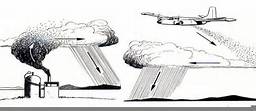
  • 19% believe we will have weather control within the next 50 years.
  • 33% believe we will have long-term space colonies within 50 years.
  • 39% believe we will have teleportation with 50 years as well.

Future Babble

Future Babble coverWhy do we try to predict the future? According to Dan Gardner, it's because of our human need to protect ourselves that we are constantly attempting to recognize risk before the lions, tigers and bears descend upon us. In Future Babble: Why Expert Predictions are Next to Worthless and You Can Do Better, Gardner provides historical insights on the types of futurists able to make the most reliable predictions. Guess what? Those predictions don't come from experts in a field, they come from people with a wide range of knowledge looking at trends from different angles.

Ventus

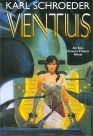
Ventus book coverVentus is one of those scifi novels that strikes a great balance between plot, characters and new technologies - and a few old ones. One of my favorites and it's free on his website (or you can donate something for a novel that offers both education and entertainment with 4 stars on Amazon and 4.6 on Manybooks) if you're looking for something to occupy your weekend until winter finally sails away.

What happens if data disproves your viewpoint?

Data.gov iconEven as an (very) amateur futurist (you have to start somewhere), you run across information that challenges perceptions - both your own and those you see every day. One of the biggest lessons I've learned through my research/writing is that any lack of objectivity skews your viewpoints on the future. I can and should include my beliefs, values and desires, but too much subjectivity and any forecasts are little more than daydreams or nightmares.

Pages