Soft Apocalypse
 Printer-friendly version
- Contains explicit material
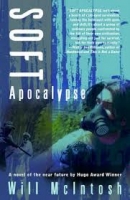 As atmospheric carbon rises towards 450 units per million and the pitch of climatologists reach higher levels of alarm, Soft Apocalypse offers a worst-case scenario of what a slow collapse of society might look like from the inside. Where McIntosh's Bridesicle/Love Minus 80 revolved around a misuse of life-saving technology, Soft Apocalypse is an avalanche of Hell unleashed on our planet. It is futurehorror without a Freddy or Michael, where the bad guys numbered in billions around the globe. Many of them bad guys who live among us today, but who haven't been forced to show their true natures as long as the distractions of civilization keep them in check.
This story could easily be the world outside as everything unraveled in Cormac McCarthy's The Road. Watching the slow collapse of society through Jasper's narrative, we see humanity returning to its fierce roots as the veneer of civilization is slowly stripped away. Soft Apocalypse is a message you live through as you read it.
Why you should read this book
Many futuristic storylines offer a technology filled dystopia. Soft Apocalypse is the opposite. It's modern America breaking down as the benefits of our modern lifestyles, culture, and society break down and fade towards anarchy. I could attempt to explain the feeling the book provides, but two quotes stood out at me and fleshes events out very well:
Colin slowed, tried to work something out of his shoe, then continued. "Shouldn't we be getting used to all this? Being dirty, not having laptops?" Sweat was pouring down his cheeks, disappearing into three days' growth of whiskers. There was a hint of white in the whiskers.
"I think we get used to improvements in our lives," I said. "I'm not sure we ever get used to having those improvements taken away."
"Ever?" he said.
"Only until we die. Whatever you do, don't let your kid know how good things used to be."
That last line hurts - especially for those of us with children. Once you know the characters, know the setting, and feel their pain, it's a blow to the chest. Things are so bad that I wonder if I would choose to bring my daughter to live in that future. It isn't an easy thought.
The second quote has less impact, but sums up the changes and how much adaptation the characters have been through:
"Shall we to the slide?" she said when her laughter had settled down to intermittent bursts.
"We shall," I said, motioning ladies first. It felt so good to be laughing, to be having fun and goofing off. Phoebe was so quick-witted; I didn't remember her being like that when we met all those years ago. Of course, we'd only spent a couple of hours together.
"Did you go to traveling carnivals a lot when you were a kid?" I asked as we picked our way across what had once been the midway.
"All the time. It's hard to imagine a time when things were that easy. You worked, you bought groceries, you took your kids to the carnival." She shook her head. "It's like some fairy tale world."
And that's how it feels, this future where places in the US - places I've visited - are shells of their former glory. Where cities are just a collection of survivors and even the police limit their involvement as they can.
But don't get the idea McIntosh's future is without advancements. Custom viruses plague the world, now that governmental and global oversight groups such as the CDC no longer appear to have their previous influence. Viruses and other infectious agents are a constant threat for many reasons, with death seeming the least of these outcomes. One scene, with the key name removed to avoid too many spoilers, in which a character is infected with a custom virus, sums up a future where lives are changed as the world adapts to new challenges:
I went downstairs, past the others, who were trying to figure out what the hell was going on, and shoved the kitchen door open. "Did you infect her?" I shouted at Sebastian. He was examining his wounded shoulder. Blood was dribbling off his elbow, splattering on the floor.
"Oh, yeah," he said. He looked up at me, grinning like a loon. "How could I not? Every minute is excruciating for that poor girl. Can't you see it? I alleviated the suffering with one pinprick." He snapped his fingers.
"It's not up to you!" I said. "You don't get to decide that for her." He shrugged.
"I did, though." A few drops of blood dripped onto the tile floor. Sebastian tisked and shook his head, still smiling. "Don't worry about it. She'll thank me in a few hours."
So we get a future where the world is crumbling, but advancements are still happening. Advancements made with the best intentions, though their value is not unanimous..
My gut response is that every human on the planet should read Soft Apocalypse or something of equal value. It's an Everyman dystopia, where the main actor is rarely the protagonist, and each of us should easily identify with the struggle. And the layers of change are persistent as only a great storyteller can manage. A great example of this is a powerful contrast between my 24 hour news cycle covering the world's minutiae and the story's drip-drip-drip of rumor about events around the globe.
Through these fragments of information, we watch a world circling down the drain as climate change increases political friction to a boiling point. A cycle of global friction putting nations at war and poisoning each other in retaliation. The future McIntosh presents is exactly the reason why we should be working to provide a better future for ourselves. Soft Apocalypse is an important work that should be in every futurist's reading list.
Topics covered
Futurists will enjoy (or at least learn from) the topics explored in the book, including:
- Societal change as our infrastructure breaks down.
- The many real issues of anarchy and fending for yourself.
- How groups splinter apart in the face of dwindling resources.
- The use of custom viruses to create or handle problems.
- A gritty feel for what life is like for many who find themselves displaced due to war or corruption tainting their homes and region.
If you enjoyed this review and plan to purchase this movie, please consider buying the novel through this link.
Your overall rating:
Quality of the work (writing, art, photography, etc):
How believable?:
How original?:
Story tags (elements of how we live):
- Commerce (trade)
- Communication
- Conflict (combat)
- Diet (food preparation and preservation)
- Energy management (energy creation)
- Flora and Fauna (living nature)
- Government (representation)
- Human form (adaptation)
- Medicine (health)
- Synthetic life (biocreation)
- Travel (locomotion)
- Vocation (occupation)
- Weather (the elements)
Location of story:
Years into the future:
 Interested in the social impact of our future advancements, Daryl developed and built Regarding Tomorrow as a platform to share and discuss our collective hopes and fears of the future. Daryl's background is in education, including graduate studies in special needs and a masters in instructional technology from UVA's Curry School of Education. He has worked as a high school teacher and has over 10 years of university experience in the US and Canada.