Habitation (dwelling)

Where will technology and big data take our future?

Stratasys 3d printed shoes

Technology is slowly infiltrating every area of our human existence. I read Alistair Croll's Race Alongside the Machine today on re/code and it led me to a reflection on how we humans are being changed by the technology we develop and where this might lead in the future.

When I came up with the original idea for a future-focused site, I immediately created a short list I called "aspects of human existence." I've changed them to "elements of how we live" and use them as story tags, a taxonomy vocabulary in Drupal terms, in order to help users find content. After reading Croll's piece, I decided today's exercise would be to look at the (now much longer) list and see what I can come up with for where current trends and predictions will take us as we continue to combine humans, technology and big data.

Can we find another planet comparable to Earth?

EarthScience fiction commonly presents a universe full of Earth-like planets, each capable of sustaining human life with only a few changes to terraform into a near-perfect environment. Popular Science offers an article that explain the five characteristics required to match Earth and another that presents all of the known explanets in graphics helping understand how few match these characteristics.

The characteristics are:

  1. Earth size, with a rocky structure...
  2. Near a sunlike star, but not too close...
  3. With liquid water...
  4. Biosignatures...
  5. ...and intelligent life.

Can current cities be redesigned for a future of healthier citizens?

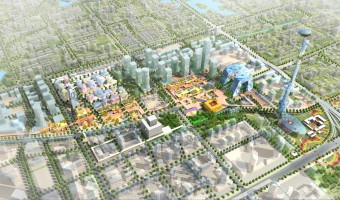
Isometric view of a cityCities are dense life centers offering a greater range of opportunities and services than those typically present in rural settings. While this offers a strong draw to people looking to take advantage of the wealth and income cities offer, organic growth of urban areas can decrease efficiency and home values when the settings become too complex and disorganized to remain inviting. Urban decay then leads to increases in crime and can be connected with shifts towards suburban settings, which in turn increase air pollution. It's a complex problem that has largely been met with middling results. Can new trends in urban planning help reclaim urban zones?

The World Health Organization forecasts that 60% of humans will live in a city by 2030 and the number will rise to 70% by 2050. Bigger, higher, denser - the characteristics of cities around the world involve a lot of words ending with '-er' - such as dirtier as air pollution increases along the population curve.

Tiny living space with space-saving ideas

Disappearing tableBack in November, I posted about Japanese Micro-apartments and how they might offer the feeling of space confinement on long-voyage space vessels. On a happier note, Spanish architecture firm Elii takes a tiny (620 square feet) living space and redesigns it to offer useful elements such as hidden storage, disappearing eating space and maximal sunlight penetration.

Eradicating Global Poverty

Poor under a tarpJanuary is being celebrated as Poverty Awareness Month. Several articles on the state of poverty have been written, but two of the more interesting ones I've read come from two very different viewpoints. The first is Bill Gates' annual letter, outlinging his concern and attempt to update "3 myths that block progress for the poor." The second is an article by Dale Hanson Bourke, "Why Am I Not Poor?", on Christianity Today where she reflects and contrasts her context and experiences with individuals living in poverty who she has met around the world.

Ideas for dealing with rising ocean levels

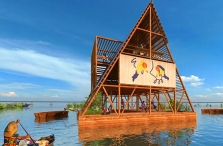
Floating school plan for NigeriaUsually, lists of interesting pictures do little more than stoke the imagination. That's great, but it's so much better when you can see some interesting ideas that could actually solve real issues. An article on Discovery.com provides a dozen ideas for dealing with rising ocean levels and also creating energy (I assume because land-based energy sources will use too much important above-water property).


Avoiding the worst effects of radioactive fallout

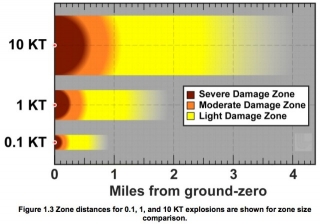
Graph showing damage zone based on tonnage of explosion.Annalee Newitz of IO9 interviewed Michael Dillon, an atmospheric scientist at the Lawrence Livermore National Laboratory. They focused on Dillon's research about how the government should respond in a disaster scenario where an airborne threat can continue to spread. If you're interested in future scenarios happening after a man-made calamity, this is a great source of information.

Interview on IO9

Dillon's study on Royal Society A


The future of privacy: the necessary data or a march towards a future of corporatocracy?

Prism logoThe combination of governmental and corporate data tracking are enabling outside entities to track increasingly granular details about our lives and interactions. Most of the reasons offer positives and are focused on protecting citizens or providing services we find useful. In order to do these jobs more efficiently, inroads to more data are critical in order to query across enough channels to create accurate connections such as identifying a terrorist organization's leader or helping us make certain we get enough exercise per day.

Sleeping on the ISS in a small room with a sleeping bag wall

Until we get artificial gravity or stations large enough the circular motion of the station can keep us pressed against the outer walls, we have to live, work, play and sleep in zero gravity. Check out this quick 2:18 video presenting Koichi Wakata giving a tour of his sleep space.

Via Wired

3D printed homes in a day

3D house printerProfessor Behrokh Khoshnevis from The University of Southern California is testing a process called Contour Crafting, which is a way of 3D printing homes. It's basically a robot that extrudes concrete to provide the frame for a building. The process begins by printing hollow walls that are then filled with a solid wall of concrete for maximal structure. From there, human workers complete the home by hanging doors, installing windows, laying flooring, etc...

Check MSN's article for a better overview. Freshome's article includes Dr Khoshnevis' TEDx video.

Pages