Posthumanity (cyborg)

An Hour with Will McIntosh

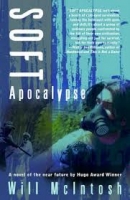
http://www.amazon.com/gp/product/159780276X/ref=as_li_tl?ie=UTF8&camp=1789&creative=390957&creativeASIN=159780276X&linkCode=as2&tag=regardtomor07-20&linkId=HTYCIYXBI2SHEYDAIf you aren't familiar with Will McIntosh, he isn't surprised.  Like many authors, Will is happy just to have a writing career and thankful for the opportunities his readers provide, even if his name isn't well known. But given the quality of his previous work and a new young adult science fiction series in development (The first novel, Burning Midnight, is scheduled for 2016), don't be surprised if you start hearing his name more often.

But you should know his short story "Bridesicle" won the Hugo Award for Best Short Story and also the Asimov's Reader Poll in 2010. It was also a finalist for the Nebula Award for Best Short Story that same year. His short version of "Soft Apocalypse" was a finalist in 2005 for both the British Science Fiction and British Fantasy Awards.

Magic Leap: A Virtual World In Our Reality

Magic Leap has pulled in half a billion in funding from names such as Google and is the brainchild of a medical robotics billionaire and a cofounder of Weta Workshops. Sean Hollister at Gizmodo provides a deep look into the history of the company and looks at their current work - including hands-on opportunities, patent information, and hiring practices – to see what they’ll be selling in the future.

It’s a lengthy article with several videos, some as long as 22 minutes. And that video is an excellent look at Magic Leap by Graeme Devine and worth the time to watch.

Do We Need Humans?

Robot workerThere is a lot of speculation on the technological singularity - the point at which artificial intelligence has progressed beyond human intelligence. Between AI and advanced engineering, humans could quickly become extraneous to modern society, especially from the viewpoint of those who own the robots and see extra humans as needful beings who return little to the planet.

That's a very dystopian view, but a possible outcome all the same. The February 28, 2014 episode of NPR's Ted Radio Hour offers four viewpoints on the future of humanity.

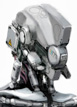
Robot concept art from Elysium by WETA concept artist Aaron Beck

Robot head from Aaron Beck's concept art for ElysiumWETA artist Aaron Beck has worked on Avatar and District 9. If you're looking for interesting artwork to stoke your imagination, he has a blog post including dozens of his concept art images for Elysium including 20 robots, 9 synthetic organisms, and a dozen weapons, along with cars, characters and fight scenes.

River of Gods


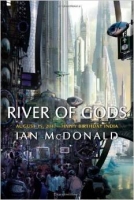
River of Gods coverIt's 2047, a hundred years after India gained independence from Britain, River of Gods is set in a country now broken into smaller nations. There hasn't been a monsoon season in years, resulting in a parched region with a Ganges trickling through Varanasi after being dammed upstream - a dam that has two nations on the edge of war.

The world is a different place in 2047. Genetic modification is everywhere, including superchildren and gender neutralizing body modifications. Artificial intelligence operates at different levels, some of them above the limits banned by international treaty. Otherwise, much of India is still poor, water is even more scarce, and the caste system carries on with only a few adjustments.

However, the Americans have found something deep in space. An object that causes a lot of questions and sends a specialist in search of her former lover. In India, someone else finds him first, someone with a strange past and who might not be completely human. Meanwhile, Mr. Nandha, one of the Krishna Cops, is hunting aeai's (artificial intelligence) with his team.

A winner of the British Science Fiction Association award and a nominee for both the Arthur C. Clarke Award and Hugo Award, River of Gods is a wild ride through a futuristic Indian culture. The complexity of the story, presenting normal human lives and emotions intertwined with decades of advancements, presents a believable backdrop against which events unfold.
Robocop (2014)

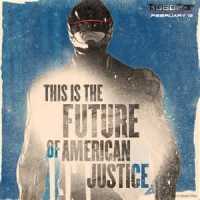
Robocop posterA future of robots replacing military and police personnel is just a matter of time. The new Robocop, a remake of the 1987 cult classic, bases the need for a cyborg police officer after mass refusal of robotic policing of US citizenry. To put a human face on the next age of police service, detective Alex Murphy is used to operate a new body that makes him a cyborg supercop and his success will provide acceptance for OmniCorp to begin selling robots to police all over America.

As part of the Robocop system Alex influences, but doesn't always control, the police software or the body it operates. The film explores his posthumanity and the line where the human ends and the robot begins - or the other way around. Seen as the Future of American Justice, Alex/Robocop works through issues at a personal level while acting as the star of the Detroit police department and a pawn of OmniCorp's need for new contracts.

I, Robot (2004)

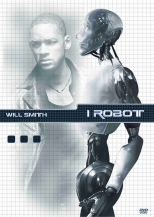
I Robot movie posterBased on the Asimov short story collection of the same name, I, Robot explores a society where humanoid robots are everywhere, doing a range of jobs, through a detective who is distrustful of robots due to a tragic accident he survived, but others didn't. As a result, when a murder happens and a robot could be responsible, the detective has to overcome doubt that a robot, required to follow the Three Laws of Robotics, could kill a human.

Another action science fiction film based on Asimov's work, the film is set in a future with many many societal changes, yet still feels incomplete. The movie is almost too clean, another clean utopia containing devoid of nature (except the cat, gotta save the cat). Yet the benefit of that sanitized environment is the way the crime stands out. Everything looks so clean and feels so efficient, you have to wonder whether any crime happens at all. For that reason, the CGI worldbuilding works for the film, though I have to wonder if a future remake with grittier writing and scenes might offer a more believable setting.

The Machine - 2013 film

The Machine

A true sci-fi thriller, The Machine presents a future where artificial intelligence is closing in on human-level capabilities and governments race to develop human-like robotic soldiers. After a cold war with China has caused a severe economic depression in the West, research into artificial intelligence is viewed as THE research to win what is considered an unavoidable war. The desired outcome is a superior soldier capable of managing a "three-block war: the battle, the negotiations, and the peace."

While too many recent science fiction films have focused on famous actors and fast scenes, adding layers of action to cross genres, The Machine is a true sci-fi film (there is action, but most of the movie is slow and moody as developments take time). Both dark and gritty, it feels like a better view of the future than the ultra-political Elysium or any film dealing with human-alien strife. Swinging for the fence, Caradog James, writer and director of The Machine, bangs one out of the park.

Pages