Novel (fiction)

Soft Apocalypse

Soft Apocalypse book coverAs atmospheric carbon rises towards 450 units per million and the pitch of climatologists reach higher levels of alarm, Soft Apocalypse offers a worst-case scenario of what a slow collapse of society might look like from the inside. Where McIntosh's Bridesicle/Love Minus 80 revolved around a misuse of life-saving technology, Soft Apocalypse is an avalanche of Hell unleashed on our planet. It is futurehorror without a Freddy or Michael, where the bad guys numbered in billions around the globe. Many of them bad guys who live among us today, but who haven't been forced to show their true natures as long as the distractions of civilization keep them in check.

This story could easily be the world outside as everything unraveled in Cormac McCarthy's The Road. Watching the slow collapse of society through Jasper's narrative, we see humanity returning to its fierce roots as the veneer of civilization is slowly stripped away. Soft Apocalypse is a message you live through as you read it.

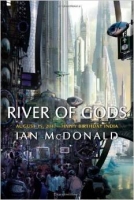
River of Gods


River of Gods coverIt's 2047, a hundred years after India gained independence from Britain, River of Gods is set in a country now broken into smaller nations. There hasn't been a monsoon season in years, resulting in a parched region with a Ganges trickling through Varanasi after being dammed upstream - a dam that has two nations on the edge of war.

The world is a different place in 2047. Genetic modification is everywhere, including superchildren and gender neutralizing body modifications. Artificial intelligence operates at different levels, some of them above the limits banned by international treaty. Otherwise, much of India is still poor, water is even more scarce, and the caste system carries on with only a few adjustments.

However, the Americans have found something deep in space. An object that causes a lot of questions and sends a specialist in search of her former lover. In India, someone else finds him first, someone with a strange past and who might not be completely human. Meanwhile, Mr. Nandha, one of the Krishna Cops, is hunting aeai's (artificial intelligence) with his team.

A winner of the British Science Fiction Association award and a nominee for both the Arthur C. Clarke Award and Hugo Award, River of Gods is a wild ride through a futuristic Indian culture. The complexity of the story, presenting normal human lives and emotions intertwined with decades of advancements, presents a believable backdrop against which events unfold.

Afterparty

Afterparty book coverSet in the near future, Afterparty explores a world where psychoactive drugs are printable. All you need is a chemjet printer and an Internet connection to begin printing designer drugs on paper, which is torn up and digested for each hit. The story follows Lyda Rose, one of the five founders of Little Sprout, a group trying to find a cure for schizophrenia, a condition from which Lyda's mother suffered.

The group is successful and Numinous is ready for trials when an event changes their lives. In high enough doses, Numinous permanently alters the user's perception by imprinting a bond with whatever god they believe in, often paired with hallucinations of a holy figure to watch over or even run their lives. Lyda believed the recipe was off the market, but then someone shows up in her ward who is clearly under its effect.

Angered by this, Lyda leaves care early with plans to find the source. With help from a few friends, not all of them real, she goes on a thrilling adventure across Canada and the United States in search of answers.

Love Minus Eighty

Love Minus Eighty book coverWelcome to the early 22nd century. Social media connects the elite in real time, and the digital divide has birthed a divide so complete it has manifested a near-complete physical disconnect. And while our mortality has not been conquered, reanimation has been perfected for those who can afford it. For those who can't, there is 'freezing insurance.' And for pretty, young women who can afford insurance, but not reanimation, there is a partial life in the 'bridesicle' dating service, where if you're pretty and willing enough, a one-percenter might marry you on your deathbed before taking you home as a bride-slave.

Will McIntosh's short story "Bridesicle" won both the Hugo Award and Asimov's Reader Poll in 2010, and was a finalist for the same year's Nebula Award. Love Minus Eighty is based on the short story and a brilliant dystopian look at a future that forecasts many of today's headline issues. McIntosh offers a very engaging world where the storyline shifts between High Town and the suburbs, contrasting the have's and have-not's of the world. Looking at the social changes, it feels like McIntosh did a good job of taking some of our current systems such as social media and incoming advancements such as life-expansion and autonomous systems forward in ways that are both promising and sour to current tastes.

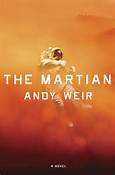
The Martian

The Martian book coverA Martian storm forces Mark Watney's crew to end their mission just a few days into their 31 days on Mars. Separated from his crew, Watney is left behind to find ways to survive with slim hope of a rescue. An engaging novel from page one, The Martian provides detailed engineering and scientific realities as Watney, a botanist and engineer, overcomes a range of issues in his quest to survive as the lone occupant of the planet.

I'll make no bones about it, The Martian is the best novel I've read in years. Weir picks up right at the beginning of Watney's realization his crew has abandoned him, and keeps you on the edge of your seat. In addition to Watney's perspective, he includes the workings and politics of NASA, and presents a world where all of Earth is rooting for one of our own stranded alone. Weaving it all together offers the reader a roller coaster full of science and engineering that will teach as much as it entertains.

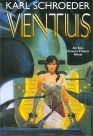
Ventus

Ventus book coverVentus is one of those scifi novels that strikes a great balance between plot, characters and new technologies - and a few old ones. One of my favorites and it's free on his website (or you can donate something for a novel that offers both education and entertainment with 4 stars on Amazon and 4.6 on Manybooks) if you're looking for something to occupy your weekend until winter finally sails away.

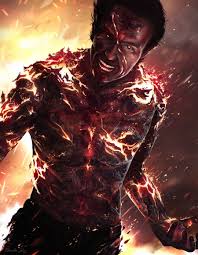
Extremis - Iron Man becomes posthuman

ExtremisWarren Ellis introduced the Extremis concept to Iron man in a 6-issue story arc starting in January 2005. This arc changed Tony Stark from a cyborg to a posthuman by introducing nanotechnology into his body and altering his physiology to include direct connections with the Iron Man suit. Ellis introduced many concepts and characters that were used in the Iron Man movie trilogy, especially Iron Man 3.

If you're into superhero comics, this is a short arc you don't want to miss. It's available on Marvel Unlimited or through Amazon. In typical comic-book style, it takes some complex scientific breakthroughs and turn them into a magical elixir, yet it brings many of the reasons we research posthuman adaptation into perspective given Stark's need to deal with the story villains. And there are a few great conversations in which characters wax philosophical about their Frankensteinian need to create a future that might be more monster than they would like.