Government (representation)

The impact of life extension

Katherine Helmond getting her face stretched in the movie BrazilPromises to extend lifespans keep rising. Some online surveys peg my lifespan between 76 and 88 years old, but specialists are claiming lifespans as long as 140 years for some humans as medicine provides the ability to regenerate, grow, or print and replace human tissue. With ongoing breakthroughs in organ printing, providing they can get bodies to accept the replacements, it is theorized the replacement of every body part with the possible exception brain can be replicated and the limitation with the brain is shifting our persona/character/self/soul into a viable replacement - an advancement that could truly create immortality.

If this turns out to be true, then science is really looking for ways to keep the brain healthy and living for a longer duration. Looking back at Bruce Sterling's novel Holy Fire, the character Mia lives by the rules governing her participation in a lifetime-enhancement program. I'm not certain longevity won't be available to the masses, or at least those who can afford the payments for procedures or insurance to cover the costs, but I do suspect Sterling got it right that longevity will be a privilege and not a right.

The Escape

Bring Back Our GirlsAbeo heard and felt her phone signaling. Not the ringing of a call or vibration of an update, but the signal of alarm. Around her, the other girls in her school pulled out their phones to read the same message. The conversations of the cafeteria grew raucous, as if quiet was really possible in a school at lunch, and teachers began to usher everyone towards the parking lot.

Buses were being started outside, starters cranking antiquated engines to life. While some technologies had made it to their corner of the world, gas and diesel engines remained the norm for at least a bit longer. Electricity was now everywhere with solar panels costing very little for a day's energy, but vehicles with batteries went to regions with more money to pay for them.

Overhead, small flocks of drones buzzed to the sky taking a quick reconnaissance of everything that moved - even in their part of Africa, nearly anything that moved was tracked in some way. Abeo climbed into the front seat and waited while the bus filled with her peers. She pulled up the pages linked from the warning and, reading between the lines of governmental jargon, discovered that suspected terrorists were blitzing their small city.

The Machine - 2013 film

The Machine

A true sci-fi thriller, The Machine presents a future where artificial intelligence is closing in on human-level capabilities and governments race to develop human-like robotic soldiers. After a cold war with China has caused a severe economic depression in the West, research into artificial intelligence is viewed as THE research to win what is considered an unavoidable war. The desired outcome is a superior soldier capable of managing a "three-block war: the battle, the negotiations, and the peace."

While too many recent science fiction films have focused on famous actors and fast scenes, adding layers of action to cross genres, The Machine is a true sci-fi film (there is action, but most of the movie is slow and moody as developments take time). Both dark and gritty, it feels like a better view of the future than the ultra-political Elysium or any film dealing with human-alien strife. Swinging for the fence, Caradog James, writer and director of The Machine, bangs one out of the park.


Will the future reduce our work hours?

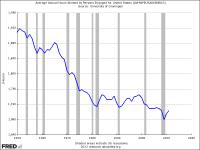
Average yearly work hours for AmericansIt's a complex issue and there are bound to be unexpected consequences. Historic data show reduced hours per American workers since 1950 when the average American workers' hours were 1,920 per year to 1700 in 2012. Averaged per week, our work week has shrunk from 37 to 33 hours per week in 60 years.

Sadly, these work hour reductions aren't spread evenly. While the work week has shrunk, it has more to do with companies reducing their full time positions to reduce benefit costs. In truth, salaried employees and specialized blue collar workers have seen an increase in their hours since the 1980's. At Salon, Sara Robinson offers a history of the 40-hour work week, including how it came about and why it is becoming more rare of late.

Providing flexible education for a robust economy

Digital classroomIn 2010, I attended a the New Media Consortium's summer conference and Peter Smith's presentation "The End of Scarcity: Can We Handle It?" Part of the presentation focused on America's current intellectual capacity and how quickly we could fall behind China and India as those nations continue to birth dozens of children for every one in America. As he mentioned in the session, in China's high schools, the top 20% outnumber America's entire class of graduating seniors. As a result, we're at risk of being outperformed based on sheer numbers - a real issue we must deal with in order to retain our place in a world economy.

Smith makes the point we must maximize every American's potential and offer a range of programs capable of providing skill mastery through easily accessible and time-flexible learning opportunities. What changes might we see to maximize opportunity? Here are two articles providing a look at the future of education and post-secondary education specifically.

The Bourne Legacy

Bourne Legacy cover

Sometimes a great look at the future shows up in places you weren't looking. The Bourne Legacy, the sequel to the trilogy with Jeremy Renner (Hawkeye in the Avengers) taking the lead role, is a fast-paced look at posthumanism and one of the better futurist films I've watched in some time.

I'd mostly ignored Legacy, figuring it would eventually hit Netflix, but found it in the library on Blu-ray this week and picked it up. Finding some free time today, I started watching and was blown away as the back story came together piece by piece. Sometimes the best views of the future arrive in a medium other than science fiction.

Stop here if you don't want to read spoilers. But this is a great movie and worth checking out.

Future Babble

Future Babble coverWhy do we try to predict the future? According to Dan Gardner, it's because of our human need to protect ourselves that we are constantly attempting to recognize risk before the lions, tigers and bears descend upon us. In Future Babble: Why Expert Predictions are Next to Worthless and You Can Do Better, Gardner provides historical insights on the types of futurists able to make the most reliable predictions. Guess what? Those predictions don't come from experts in a field, they come from people with a wide range of knowledge looking at trends from different angles.

Dan Abelow: The journey to our full potential

House comparisonFuturists often explain our potential consumption in the number of planets we would need if everyone lives like a Westerner with large homes, multiple cars, and a dependency on consumerism to drive the economy - the last count I read was six Earths. It's a fair assumption and a questionable habit. In fact, I believe teaching my daughter to control her consumerism will be a key asset in her future no matter where or how she lives.

As part of an ongoing series to introduce his new book, Dan Abelow introduces chapter 1.2 about the Age of Crisis, which he refers to as The Crisis of Success. He sums the crisis up very well in a single sentence:

Our growing Crisis of Success comes from who we are: Everyone wants it all, wants it now, and won’t stop.

Ventus

Ventus book coverVentus is one of those scifi novels that strikes a great balance between plot, characters and new technologies - and a few old ones. One of my favorites and it's free on his website (or you can donate something for a novel that offers both education and entertainment with 4 stars on Amazon and 4.6 on Manybooks) if you're looking for something to occupy your weekend until winter finally sails away.

Pages