Providing flexible education for a robust economy
 Printer-friendly version
 In 2010, I attended a the New Media Consortium's summer conference and Peter Smith's presentation "The End of Scarcity: Can We Handle It?" Part of the presentation focused on America's current intellectual capacity and how quickly we could fall behind China and India as those nations continue to birth dozens of children for every one in America. As he mentioned in the session, in China's high schools, the top 20% outnumber America's entire class of graduating seniors. As a result, we're at risk of being outperformed based on sheer numbers - a real issue we must deal with in order to retain our place in a world economy.
Smith makes the point we must maximize every American's potential and offer a range of programs capable of providing skill mastery through easily accessible and time-flexible learning opportunities. What changes might we see to maximize opportunity? Here are two articles providing a look at the future of education and post-secondary education specifically.
The first is an op-ed column by David Brooks titled "The Practical University." It asks some hard questions about the role of higher education and separates the role of higher education into two types of knowledge: technical knowledge and practical knowledge. Technical knowledge is information easily detailed and presented. Practical knowledge, from his examples, includes learning how to work in groups, interact with social systems, and handle disagreements.
One detail Brooks misses is the application of technical knowledge (though he hints at it when quoting Nelson in the sixth paragraph), which often requires specialized labs and assignments to master hands-on techniques. If we call this "application knowledge," I believe we have a more complete view of higher education. Technical knowledge can be transmitted via multiple channels, letting learners choose what works best for their time, location, and learning preferences. A university can use MOOC courses to provide foundational information by providing students with a deadline by which they must complete a required course (either a preselected MOOC course or one meeting specific requirements for transfer credit) with a minimal grade. Courses where technical knowledge is then applied would require students to complete work on campus to earn upper level credits.
Higher education must change and new advancements in technology will offer greater flexibility to the student. How universities use this flexibility remains to be seen, as they will prefer students complete all work through their systems. Universities are, after all, expensive to build and maintain. Losing credits to less expensive, online offerings will cut into their budgets and cause a contraction in that market. Of course, if they don't find a way to work with these new services such as MOOCs, they also run the risk of potential students creating their own curricula, presenting their skill set to potential employers in place of more expensive diplomas.
Meanwhile, university and college programs are one of the only places students can experience and practice the three types of knowledge that are key to post-university success and access some programs providing the certification to earn employment in certain fields. Replicating all three online is a far off goal, if all three can ever be replicated at all.
Yet this does feed into my belief that university degrees may lose value if employers are able to mine applicants for specific skill sets and behavioral patterns. While education slowly adapts to a fast approaching future, employment websites are offering testing to score an applicant's ability in specific skills. In some fields, these scores might not earn you the same as a diploma, but could allow the opportunity to avoid the expense of full-time tuition and income loss for those years attending school. Once employed and earning the workplace experience that sets them apart from competitors, lifelong learners might continue to earn credits towards a degree in their free time and possibly subsidized by their employer.
Expensive universities should be wary of losing students to a new world where their demographic drops out to work, earn, learn and get their degree online at a fraction of the cost of a four year institution. If employers find managers who can patiently teach practical knowledge in the workplace, that skill set so often connected with higher education is no longer owned by the Ivory Tower.
_________________
The second article, "Signs of peak higher education: the return to vo tech," focuses on an America where four-year program attendance has peaked from a combination of rising tuition and decreased chances of employment. Bryan Alexander looks to vocational technical schools as a new path for students and families unable or unwilling to take on debt in a market where the chance of payoff is shrinking. Alexander's view matches well with Smith's viewpoint that every opportunity matters - that each American must have access to the appropriate path for their interests and abilities, especially access to affordable opportunities.
Consider that by expanding certificate and two-year programs such as AAS degrees, and combining those with the same flexibility infiltrating higher education, America becomes ever more flexible as a society - able to maximize each citizen's intellectual capacity, creativity, and interest level. Furthermore, offering clear transfer options for credits allows graduates of these programs to continue their studies towards more advanced degrees.
Alexander goes on to point out that merging the newest advanced technology skills such as 3D printing with more traditional certificate programs will increase their impact and attractiveness. From a social standpoint, they would also support new technology and advancement adoption by increasing reliability and efficiency. By providing affordable and knowledgeable support of these changes, factors that support innovation and adoption, their adoption offers less risk.
_________________
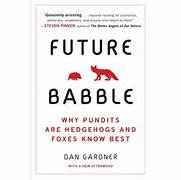 A personal note: Going back to Dan Gardner's Future Babble, I'm wary of becoming a hedgehog when forecasting in the field of education. As my primary area of experience, it would be easy to fall (fail?) into an "expert" mode. The truth is, education as a field is both wide and deep with nuance at each level and differences from state to state and district to district. The ideas in this article were eye-openers that changed my viewpoint in some way. Smith's presentation informed on the need of the society to help individuals maximize their potential, a different view from the "ladder to success" mentality I previously held, which developed during my student years. Brooks reminds me of the basic purpose of education and why we invest so heavily in the opportunity, even though there are so many more growth opportunities on every campus. While any learning setting offers a wide range of learning opportunities, the birds-eye view is required to understand how each is approached and might change in the future. Finally, Alexander's piece should remind us that beyond the glitter of four-year universities represented by sports heroes, experts in their fields, and party atmospheres, lie the vocational schools through which so many of our fellow citizens learn the skills we require to enjoy our modern lives and provide opportunities for their own families. They don't get nearly the credit they deserve and should always be included in any discussion of post-secondary education.
 Interested in the social impact of our future advancements, Daryl developed and built Regarding Tomorrow as a platform to share and discuss our collective hopes and fears of the future. Daryl's background is in education, including graduate studies in special needs and a masters in instructional technology from UVA's Curry School of Education. He has worked as a high school teacher and has over 10 years of university experience in the US and Canada.