Government (representation)

An Hour with Will McIntosh

http://www.amazon.com/gp/product/159780276X/ref=as_li_tl?ie=UTF8&camp=1789&creative=390957&creativeASIN=159780276X&linkCode=as2&tag=regardtomor07-20&linkId=HTYCIYXBI2SHEYDAIf you aren't familiar with Will McIntosh, he isn't surprised.  Like many authors, Will is happy just to have a writing career and thankful for the opportunities his readers provide, even if his name isn't well known. But given the quality of his previous work and a new young adult science fiction series in development (The first novel, Burning Midnight, is scheduled for 2016), don't be surprised if you start hearing his name more often.

But you should know his short story "Bridesicle" won the Hugo Award for Best Short Story and also the Asimov's Reader Poll in 2010. It was also a finalist for the Nebula Award for Best Short Story that same year. His short version of "Soft Apocalypse" was a finalist in 2005 for both the British Science Fiction and British Fantasy Awards.

Soft Apocalypse

Soft Apocalypse book coverAs atmospheric carbon rises towards 450 units per million and the pitch of climatologists reach higher levels of alarm, Soft Apocalypse offers a worst-case scenario of what a slow collapse of society might look like from the inside. Where McIntosh's Bridesicle/Love Minus 80 revolved around a misuse of life-saving technology, Soft Apocalypse is an avalanche of Hell unleashed on our planet. It is futurehorror without a Freddy or Michael, where the bad guys numbered in billions around the globe. Many of them bad guys who live among us today, but who haven't been forced to show their true natures as long as the distractions of civilization keep them in check.

This story could easily be the world outside as everything unraveled in Cormac McCarthy's The Road. Watching the slow collapse of society through Jasper's narrative, we see humanity returning to its fierce roots as the veneer of civilization is slowly stripped away. Soft Apocalypse is a message you live through as you read it.

Who owns the moon?

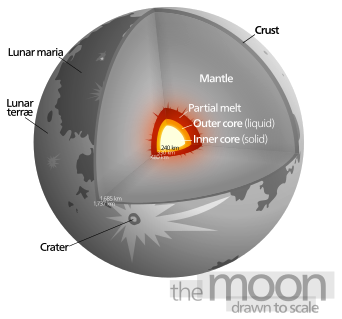
Interior view of the moonWhile there has only been a single trip to the moon involving humans, some groups view our only natural satellite as a hunk of resources waiting to be mined. In her article "Who owns the moon?" Dr Saskia Vermeylen provides an overview of the current laws and agreements governing moon property rights and how they might be handled based on current laws and treaties.

It's important to note there is another preceding treaty currently signed and ratified by a majority of nations. The 1967 "Treaty on Principles Governing the Activities of States in the Exploration and Use of Outer Space, including the Moon and Other Celestial Bodies" was designed to exclude using the moon as a base for weapons and also to limit national appropriation of moon property.

It may not be long until a new treaty needs to be discussed. Though current propulsion systems are not capable of bringing sufficient minerals back from the moon (or asteroids) to make the trip profitable, with current efforts focused on space tourism and transport, the need for more efficient methods to break free of Earth's gravity has never been more valuable. With intelligence and money being thrown at the problem, we should expect more efficient engines or alternatives within the next decade. There are many theories being researched that include space elevators, skyhooks, rail guns, and (safely) blasting it out of the atmosphere with lasers.

What will future jobs look like?

Andrew McAfee, one of the authors of The Second Machine Age, gives a presentation on the future of jobs as one of his TED talks. He provides a nice overview of the benefits and challenges of "the new machine age" and, on the human side, who will be impacted. At 15 minutes long, it's a fairly complete overview on the topic and how our societies might adapt to prepare our children and the adult unemployed for this change.

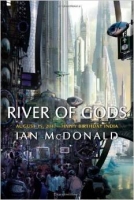
River of Gods


River of Gods coverIt's 2047, a hundred years after India gained independence from Britain, River of Gods is set in a country now broken into smaller nations. There hasn't been a monsoon season in years, resulting in a parched region with a Ganges trickling through Varanasi after being dammed upstream - a dam that has two nations on the edge of war.

The world is a different place in 2047. Genetic modification is everywhere, including superchildren and gender neutralizing body modifications. Artificial intelligence operates at different levels, some of them above the limits banned by international treaty. Otherwise, much of India is still poor, water is even more scarce, and the caste system carries on with only a few adjustments.

However, the Americans have found something deep in space. An object that causes a lot of questions and sends a specialist in search of her former lover. In India, someone else finds him first, someone with a strange past and who might not be completely human. Meanwhile, Mr. Nandha, one of the Krishna Cops, is hunting aeai's (artificial intelligence) with his team.

A winner of the British Science Fiction Association award and a nominee for both the Arthur C. Clarke Award and Hugo Award, River of Gods is a wild ride through a futuristic Indian culture. The complexity of the story, presenting normal human lives and emotions intertwined with decades of advancements, presents a believable backdrop against which events unfold.
Abundance: The Future Is Better Than You Think

Book coverIn Abundance, Peter Diamandis and Steven Kotler present trends taking us towards a better future - one in which individual needs are met on a global scale. Using Maslow's Hierarchy of Needs as a foundation, they explore technology will find ways to improve efficiency by fostering cooperation, providing access to clean water, producing enough food for a planet of nine billion, and even enabling equality as limitations dissipate.

Many projections offer a future half empty. Here, we get a lesson on how our biases enable close tracking of negative trends, whether serious, global issues or personal issues threatening a comfortable ideal we would not wish to give up. Yet, data show the world is improving. As an example, Bill Gates' annual letter from this past January presents how effective support of poor economies is stabilizing population, improving health, and helping develop economies capable of supporting human rights and freedom.

The point of Abundance is that we can both thrive as a race, free of draconian measures to tame our needs, and solve our problems going forward, using new methods and technologies to empower humanity. Why settle for half empty or half full, when the future can be filled to the brim?

Social Physics

Social Physics book coverAccording to Wikipedia, Alex Pentland's areas of research include social physics, big data, and privacy. In his book, Social Physics, Pentland takes us through the benefits and issues, such as the loss of privacy, that come from comprehensive tracking. It's a short book with a deep look at how the Internet of Things and the quantified self will collect data to change the world around us and better our lives.

Focused on human behavior, the book offers a look at the range of benefits that could result from our hyperconnected world. These include idea flow to spread and advance new ideas, methods for bringing people into problem-solving scenarios to fast prototype solutions, and ways cities can take the density of its members, services, and infrastructure together to improve efficiency while providing the best living experience for the humans who call it home. At its heart, the work focuses on ways we can use data to find better methods for improving how we work together, but it also hints at the promise of an abundant future where mountains of data provide true insight to the best ways we can work together.

While that sounds promising, Pentland doesn't look at the world through rose colored glasses, but acknowledges how this data can and will impact our privacy. So he also proposes simple laws designed to allow the collection of data while protecting citizens from its inappropriate use (at least without our permission).

Social Physics is a course in a book by one of, if not THE expert in this field. Pentland offers a thorough and digestible look at the field and what it offers our future.

Minority Report (2002)

Film posterBased on "The Minority Report," a short story by Philip K. Dick, this film explores the issue of preventing crime before it occurs. The PreCrime division, a special unit set in Washington, D.C., uses three individuals who possess the ability to foresee murders before they occur. When each case is identified, including the victim, the perpetrator, and the time, the PreCrime police use recorded visuals from the "precog's" visions to identify the location and foil the crime before it happens.

While the division has had great success and is considered perfect, the film focuses on what happens if these visions are not 100% reliable. Especially when the perpetrators are arrested and imprisoned when they were not allowed to actually commit the crime.

Blade Runner (1982)

Considered one of cinema's most influential science fiction films, the Blade Runner screenplay was based on Philip K. Dick's novel Do Androids Dream of Electric Sheep? and directed by Ridley Scott, who also directed sci fi classics Alien and Prometheus. Blade Runner is set in our near future, 2019 is only 5 years away, against a dystopian backdrop of a filthy, crowded, culturally mixed cityscape on a planet where most humans appear to have left for other colonies. As with most classics that visualized technological and ecological hell on the other side of the year 2000, the vision is not accurate. Yet, it navigates issues we are discussing today because they will be here tomorrow.

Afterparty

Afterparty book coverSet in the near future, Afterparty explores a world where psychoactive drugs are printable. All you need is a chemjet printer and an Internet connection to begin printing designer drugs on paper, which is torn up and digested for each hit. The story follows Lyda Rose, one of the five founders of Little Sprout, a group trying to find a cure for schizophrenia, a condition from which Lyda's mother suffered.

The group is successful and Numinous is ready for trials when an event changes their lives. In high enough doses, Numinous permanently alters the user's perception by imprinting a bond with whatever god they believe in, often paired with hallucinations of a holy figure to watch over or even run their lives. Lyda believed the recipe was off the market, but then someone shows up in her ward who is clearly under its effect.

Angered by this, Lyda leaves care early with plans to find the source. With help from a few friends, not all of them real, she goes on a thrilling adventure across Canada and the United States in search of answers.

Pages