Predicting the future goes hand-in-hand with preparing for the future, a skill humans have developed to survive tough times and to make their world a better place (mostly, but not always). While we live at a point where futurism is growing more mainstream, even if the term and field are not household names, futurists have made predictions for some time. Ed Fries, formerly of Microsoft, has shared his collection of century old, French futurist postcards in which artists forecast life in 2012.
The postcards depict a variety of scenes, including the one above where a family takes a trip to the moon. Others include a Skype-like system of communication, flying cars, and aquanauts riding seahorses. You can see them at Wired, in an article by Greg Miller.
A team of surgeons at UPMC Presbyterian Hospital in Pittsburgh, Pennsylvania are being allowed to place the traumatically wounded victims of gunshot wounds into suspended animation to gain time before blood loss decreases the chance of survival or, in the survivors, permanent decreases in cognitive function and memory loss. The trial will allow this one team to use this technique on ten emergency victims, who will have their body temperatures decreased to 50F (10C) with a special focus on decreasing cellular activity in the brain.
The temperature drop involves forcing cooled saline through the heart to the brain, dropping critical tissue to temperatures low enough, they no longer require an oxygen source to remain intact. Normally, brain tissue begins to take permanent damage after 5 minutes without oxygen. In these trials, patients may remain in suspended animation for up to two hours, giving surgeons more time to rebuild and repair before attempting to revive the patient.
The future holds many promises. Within my lifetime, I expect to experience a fully networked world, a life of abundance, and may live keep my health for more than a century. While technocrats and futurists discuss engineering marvels and world-changing API's, what can be done about humanity's dark side?
Our ancestors consistently looked for ways to eradicate apex predators who were a danger to their tribes by directly hunting humans and also by competing for our food sources. Today, many species of apex predators exist in controlled numbers in places we enjoy them, but rarely come into direct contact with them. To make our world safer, we've done almost too good a job as various species move closer to extinction with every successful poaching.
This past week, Facebook launched the FB Newswire, "...a resource for journalists that aggregates newsworthy social content shared publicly on Facebook by individuals and organizations." The service offers some hope that information shared through social media can become a bit more trustworthy, helping to clean up some of the misinformation and lies easily shared in an age where every person with a data line can publish content with very few restrictions.
It's an important development when the largest network in history adds a feature with this much potential impact. One of the reasons we value social media is the ability to get updates as soon as content is posted. Facebook provides sharing among acquaintances, friends, and family members while Twitter provides a near endless churn of news from any and every account and hashtag you follow. If news happens, whether the news is personal or global, we can know about it within hours, minutes, and even seconds of its posting. Sadly, the strength of social media is also a weakness when misinformation or outright lies are shared at the same speed. As Winston Churchill said...
A lie gets halfway around the world before the truth has a chance to get its pants on.
Food is one of our most basic needs, yet it represents culture, history, and individuality through our choices. Furthering our individuality, each person has medical and gastronomical limitations that add another layer of complexity to how we select what we eat. As such, it is a multilayered issue when you look at the future of food and how we might raise and prepare our food, with perhaps consumption being the only practice set in stone (unless they find a way for us to inhale our food, which doesn't sound very interesting to me).
In this futurepath, we'll look at the history of the human diet, current research on eating practices, and current food issues in order to identify how our food culture might change in the future.
"Every platform will be socialized, but every user base will be judged on quality of life, not sheer numbers. Big data will not matter as much as small relationships."
His is an interesting idea about how social media will change our relationships and our choices will reflect our interests and lifestyles. As social creatures, we have circles of relationships in which we are members and which in turn influence our lives.
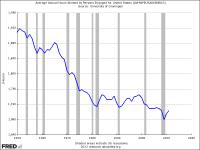
It's a complex issue and there are bound to be unexpected consequences. Historic data show reduced hours per American workers since 1950 when the average American workers' hours were 1,920 per year to 1700 in 2012. Averaged per week, our work week has shrunk from 37 to 33 hours per week in 60 years.
Sadly, these work hour reductions aren't spread evenly. While the work week has shrunk, it has more to do with companies reducing their full time positions to reduce benefit costs. In truth, salaried employees and specialized blue collar workers have seen an increase in their hours since the 1980's. At Salon, Sara Robinson offers a history of the 40-hour work week, including how it came about and why it is becoming more rare of late.
In 2010, I attended a the New Media Consortium's summer conference and Peter Smith's presentation "The End of Scarcity: Can We Handle It?" Part of the presentation focused on America's current intellectual capacity and how quickly we could fall behind China and India as those nations continue to birth dozens of children for every one in America. As he mentioned in the session, in China's high schools, the top 20% outnumber America's entire class of graduating seniors. As a result, we're at risk of being outperformed based on sheer numbers - a real issue we must deal with in order to retain our place in a world economy.
Smith makes the point we must maximize every American's potential and offer a range of programs capable of providing skill mastery through easily accessible and time-flexible learning opportunities. What changes might we see to maximize opportunity? Here are two articles providing a look at the future of education and post-secondary education specifically.