Original content

An Hour with Will McIntosh

http://www.amazon.com/gp/product/159780276X/ref=as_li_tl?ie=UTF8&camp=1789&creative=390957&creativeASIN=159780276X&linkCode=as2&tag=regardtomor07-20&linkId=HTYCIYXBI2SHEYDAIf you aren't familiar with Will McIntosh, he isn't surprised.  Like many authors, Will is happy just to have a writing career and thankful for the opportunities his readers provide, even if his name isn't well known. But given the quality of his previous work and a new young adult science fiction series in development (The first novel, Burning Midnight, is scheduled for 2016), don't be surprised if you start hearing his name more often.

But you should know his short story "Bridesicle" won the Hugo Award for Best Short Story and also the Asimov's Reader Poll in 2010. It was also a finalist for the Nebula Award for Best Short Story that same year. His short version of "Soft Apocalypse" was a finalist in 2005 for both the British Science Fiction and British Fantasy Awards.

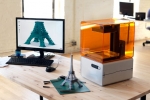
Grossout (nasty fun with 3D food printing)

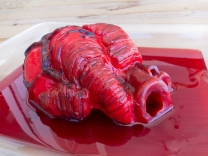
Jello heart from FlickrEach printed meal offered four bites per player. When you were targeted, you had to eat two bites and hold it down for one whole minute and then eat the last two bites before another minute had passed. Some items were so nasty the minute made the player realize he never wanted to eat the stuff again and then couldn't wolf it down before the rest of the time ran out - even if they were willing to try!

Soft Apocalypse

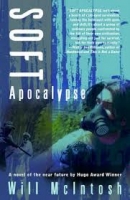
Soft Apocalypse book coverAs atmospheric carbon rises towards 450 units per million and the pitch of climatologists reach higher levels of alarm, Soft Apocalypse offers a worst-case scenario of what a slow collapse of society might look like from the inside. Where McIntosh's Bridesicle/Love Minus 80 revolved around a misuse of life-saving technology, Soft Apocalypse is an avalanche of Hell unleashed on our planet. It is futurehorror without a Freddy or Michael, where the bad guys numbered in billions around the globe. Many of them bad guys who live among us today, but who haven't been forced to show their true natures as long as the distractions of civilization keep them in check.

This story could easily be the world outside as everything unraveled in Cormac McCarthy's The Road. Watching the slow collapse of society through Jasper's narrative, we see humanity returning to its fierce roots as the veneer of civilization is slowly stripped away. Soft Apocalypse is a message you live through as you read it.

Futurepath: Human employment

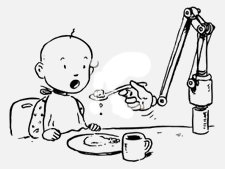
Baby fed by a robotLast year, Carl Benedikt Frey and Michael Osborne published their paper, "The Future of Unemployment: How Susceptible are Jobs to Computerisation?" In their research, they identified that nearly half of US jobs will be automated within the next 10-20 years. Since then, there is a rising sense of urgency represented by the range of articles presenting the medium to long-term career forecasting of either a world of high unemployment or a world in which robotic productivity creates a socialist scenario where all humans maintain a minimal life quality without concern over unemployment. Digging more deeply into viewpoints with more diverse data and historical comparisons show a lot more reasons to be either bullish or bearish on the future.

Futurepath: Energy

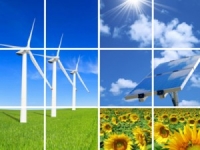
Energy mosaicFrom ultra-modern Manhattan penthouses to cell phones and radios in sub-Saharan homes, from private jets zipping over the oceans to motor scooters in southeast Asia - we require energy to power our lives. At this point, only protected Amazon tribes and the few humans who have chosen to live off the energy grid do not use any of the world's energy supplies.

Overall, we humans use in excess of 500 exajoules of energy per year. The energy we produce is derived by a variety of sources such as nuclear; fossil fuels, including coal, crude, and gas; and renewables such as wind, hydro, and solar. These fuels are broken into two main types of use, the first is locomotion via fuel burning engines and the second is the creation of electricity, which is then used as a source of power for motors, lights, appliances, and the gadgets we use (to name a few).
CryptoDNA

Microscopic view of a virusHis alarm sounded, followed by three pings to let him know that many messages were waiting. Jack rolled over, grabbing his phone off the stand and heading for the toilet. Blinking, he palmed his right eye. It was hazy, like a filmy shower door.

Taking a seat, Jack's stomach rumbled and a tension headache was working up his neck. The flu? he wondered, but a quick review of his phone's health sensors didn't show anything of concern. They weren't infallible, but they'd catch any substantial temperature increase.

Jack thumbed up the first message and squinted. Rsrv @ Ice House 8:30. Dinner with his brother, Earl. He flipped it to his calendar and pulled up the next as his stomach made a fuss. Package printed, ready for shipping. Track via Y8DK848785984. He tapped the code and it shot offscreen to his tracking software. His stomach emptied so hard he shivered.

Surrogates (Graphic novel and 2009 film)

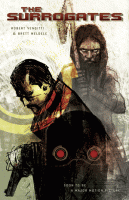
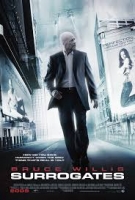
Cover of Surrogates graphic novel  Surrogates movie poster The Surrogates is a 2005 comic series that explored a future society where humans control robots from the comfort and safety of their own homes. These robots provide what appears to be perfect telepresence by connecting the owners to the outside world - without risk to their physical bodies.

The series was made into a motion picture in 2009, titled Surrogates, with a slightly altered storyline in which humans can be killed through through the Surrogate interface. In both works, investigators (police in the graphic novels and FBI agents in the film) attempt to solve a series of crimes involving attacks on surrogates, with the investigation taking them deep into societal issues between a modern world and a militant group who refuses to interact with surrogates.

They are both engaging stories exploring extreme telepresence and the positives and negatives that come with the technology. The graphic novels are thoughtful and very well written with a lot of believability. The film is science fiction as an action film, though Surrogates takes time to explore additional elements not included in the graphic novels, adding to the plot and in the background of the main storyline. It's an intelligent movie behind the gunshots and car chases.

TiMER (2010 comedy)

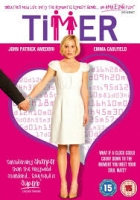
Timer movie posterWhile most science fiction uses action films to hide ways to make us think, TiMER is a relationship comedy. Set in a future where a wearable device counts down the time until the wearer is destined to meet his or her soul mate, this soft science fiction film looks at what we lose when we give too much control to a technology.

In the film, Oona (played by Emma Caulfield from Buffy the Vampire Slayer) has a TiMER that doesn't register a number - meaning her soul mate has not yet had a TiMER installed. The film explores the myriad ways the service influences how users seek, wait, and find love. It's an interesting film that is a nice break from the explosion filled dystopias Hollywood tends to produce.

No Maps For These Territories

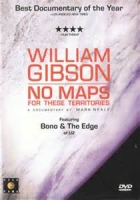
No Maps DVD coverAn independent documentary by Mark Neale, No Maps puts William Gibson in the back of a limo and provides an informal interview while riding around North America, Ireland, and the UK. Most of the content is Gibson's responses to unheard questions with the presentation coming off as a stream of consciousness.

Covering a range of topics, Gibson provides his views on culture, the current technology revolution, and his writing process. It's a rare and interesting opportunity to hear thoughts from a winner of both the Hugo and Nebula awards (both for his novel Neuromancer) and worth the time to enjoy.

Pages