Original content

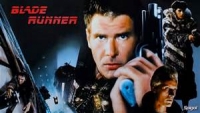
Blade Runner (1982)

Considered one of cinema's most influential science fiction films, the Blade Runner screenplay was based on Philip K. Dick's novel Do Androids Dream of Electric Sheep? and directed by Ridley Scott, who also directed sci fi classics Alien and Prometheus. Blade Runner is set in our near future, 2019 is only 5 years away, against a dystopian backdrop of a filthy, crowded, culturally mixed cityscape on a planet where most humans appear to have left for other colonies. As with most classics that visualized technological and ecological hell on the other side of the year 2000, the vision is not accurate. Yet, it navigates issues we are discussing today because they will be here tomorrow.

The Island (2005)

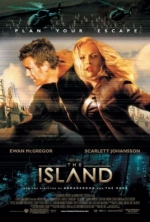
The Island dvd coverClones are big business in the future. Buy your own to supply the parts you require when sickness or injury threaten your life. The Island is a sci-fi action adventure set in the not-too-distant future, told from the viewpoint of two clones as they discover the truth of their existence and work to uncover corporate inhumanity.

Lincoln Six Echo and Jordan Two Delta are clones living in a safe, controlled world among others of their kind. History tells the outside world is too contaminated for life outside the compound, with only one remaining island clean enough to support human life. The clones live their routine hoping to one day win the lottery and move to the island, where they can live out their lives under the sun. But it's all a lie fabricated to keep them controlled and hopeful, two things necessary for the products, their bodies, to remain healthy.

Gravity (2013 film)

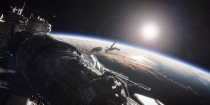
Gravity scene grabGravity is a highly detailed action thriller set in Earth's orbit. Starting with a what should be a routine Hubble Space Telescope repair, the mission ends as events threaten the shuttle and astronauts. The movie spins the lead characters, of which there are two, through a series of attempts to survive in orbit while seeking a way back to Earth.

Afterparty

Afterparty book coverSet in the near future, Afterparty explores a world where psychoactive drugs are printable. All you need is a chemjet printer and an Internet connection to begin printing designer drugs on paper, which is torn up and digested for each hit. The story follows Lyda Rose, one of the five founders of Little Sprout, a group trying to find a cure for schizophrenia, a condition from which Lyda's mother suffered.

The group is successful and Numinous is ready for trials when an event changes their lives. In high enough doses, Numinous permanently alters the user's perception by imprinting a bond with whatever god they believe in, often paired with hallucinations of a holy figure to watch over or even run their lives. Lyda believed the recipe was off the market, but then someone shows up in her ward who is clearly under its effect.

Angered by this, Lyda leaves care early with plans to find the source. With help from a few friends, not all of them real, she goes on a thrilling adventure across Canada and the United States in search of answers.
Splice (2009)

View of the spliced creatureAs genetic engineering progresses, humanity will be faced with issues of morality time and time again. Splice looks at the field of artificial life and the specific issue of combining human and non-human DNA. In the film, two researchers, facing the loss of their research, decide to combine human and animal DNA to create a new life form - just to prove it can be done. Once the birth occurs, each has a different response to the creature and those responses change over time as Dren develops towards adulthood.

The plot focuses on the different relationships Clive and Elsa have to the being they have birthed for science. Fearing their employer's response, they hide Dren and eventually mover her off site to protect her. Dren's development affects both scientists in different ways, with each responding to Dren and each other in different and sometimes horrific ways.


The impact of life extension

Katherine Helmond getting her face stretched in the movie BrazilPromises to extend lifespans keep rising. Some online surveys peg my lifespan between 76 and 88 years old, but specialists are claiming lifespans as long as 140 years for some humans as medicine provides the ability to regenerate, grow, or print and replace human tissue. With ongoing breakthroughs in organ printing, providing they can get bodies to accept the replacements, it is theorized the replacement of every body part with the possible exception brain can be replicated and the limitation with the brain is shifting our persona/character/self/soul into a viable replacement - an advancement that could truly create immortality.

If this turns out to be true, then science is really looking for ways to keep the brain healthy and living for a longer duration. Looking back at Bruce Sterling's novel Holy Fire, the character Mia lives by the rules governing her participation in a lifetime-enhancement program. I'm not certain longevity won't be available to the masses, or at least those who can afford the payments for procedures or insurance to cover the costs, but I do suspect Sterling got it right that longevity will be a privilege and not a right.

Using the past to forecast the future

Flying carPredicting the future goes hand-in-hand with preparing for the future, a skill humans have developed to survive tough times and to make their world a better place (mostly, but not always). While we live at a point where futurism is growing more mainstream, even if the term and field are not household names, futurists have made predictions for some time. Ed Fries, formerly of Microsoft, has shared his collection of century old, French futurist postcards in which artists forecast life in 2012.

The postcards depict a variety of scenes, including the one above where a family takes a trip to the moon. Others include a Skype-like system of communication, flying cars, and aquanauts riding seahorses. You can see them at Wired, in an article by Greg Miller.

Suspended animation and cryonics are no longer science fiction

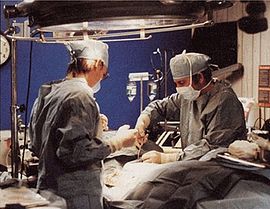
Surgeons preparing a patient for cryopreservationA team of surgeons at UPMC Presbyterian Hospital in Pittsburgh, Pennsylvania are being allowed to place the traumatically wounded victims of gunshot wounds into suspended animation to gain time before blood loss decreases the chance of survival or, in the survivors, permanent decreases in cognitive function and memory loss. The trial will allow this one team to use this technique on ten emergency victims, who will have their body temperatures decreased to 50F (10C) with a special focus on decreasing cellular activity in the brain.

The temperature drop involves forcing cooled saline through the heart to the brain, dropping critical tissue to temperatures low enough, they no longer require an oxygen source to remain intact. Normally, brain tissue begins to take permanent damage after 5 minutes without oxygen. In these trials, patients may remain in suspended animation for up to two hours, giving surgeons more time to rebuild and repair before attempting to revive the patient.

Love Minus Eighty

Love Minus Eighty book coverWelcome to the early 22nd century. Social media connects the elite in real time, and the digital divide has birthed a divide so complete it has manifested a near-complete physical disconnect. And while our mortality has not been conquered, reanimation has been perfected for those who can afford it. For those who can't, there is 'freezing insurance.' And for pretty, young women who can afford insurance, but not reanimation, there is a partial life in the 'bridesicle' dating service, where if you're pretty and willing enough, a one-percenter might marry you on your deathbed before taking you home as a bride-slave.

Will McIntosh's short story "Bridesicle" won both the Hugo Award and Asimov's Reader Poll in 2010, and was a finalist for the same year's Nebula Award. Love Minus Eighty is based on the short story and a brilliant dystopian look at a future that forecasts many of today's headline issues. McIntosh offers a very engaging world where the storyline shifts between High Town and the suburbs, contrasting the have's and have-not's of the world. Looking at the social changes, it feels like McIntosh did a good job of taking some of our current systems such as social media and incoming advancements such as life-expansion and autonomous systems forward in ways that are both promising and sour to current tastes.

The Martian

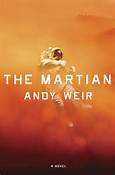
The Martian book coverA Martian storm forces Mark Watney's crew to end their mission just a few days into their 31 days on Mars. Separated from his crew, Watney is left behind to find ways to survive with slim hope of a rescue. An engaging novel from page one, The Martian provides detailed engineering and scientific realities as Watney, a botanist and engineer, overcomes a range of issues in his quest to survive as the lone occupant of the planet.

I'll make no bones about it, The Martian is the best novel I've read in years. Weir picks up right at the beginning of Watney's realization his crew has abandoned him, and keeps you on the edge of your seat. In addition to Watney's perspective, he includes the workings and politics of NASA, and presents a world where all of Earth is rooting for one of our own stranded alone. Weaving it all together offers the reader a roller coaster full of science and engineering that will teach as much as it entertains.

Pages