Abundance: The Future Is Better Than You Think
 Printer-friendly version
- No explicit material
 In Abundance, Peter Diamandis and Steven Kotler present trends taking us towards a better future - one in which individual needs are met on a global scale. Using human needs as a foundation, they explore new technologies providing methods to improve efficiency by fostering cooperation, providing access to clean water, producing enough food for a planet of nine billion, and even enabling equality as limitations dissipate.
Many projections offer a future half empty. Here, we get a lesson on how our biases enable the tracking of negative trends, whether serious, global issues or personal issues threatening a comfortable ideal we would not wish to give up. Yet, data show the world is improving. As an example, Bill Gates' annual letter from this past January presents how the effective support of poor economies is stabilizing population, improving health, and helping develop economies capable of supporting human rights and freedom.
The point of Abundance is that we can both thrive as a race, free of draconian measures to tame our needs, and solve our problems going forward, using new methods and technologies to empower humanity. Why settle for half empty or half full, when the future can be filled to the brim?
Why you should read it
Humanity faces issues today that will grow more severe as our population continues to grow. A lack of clean water, ecological damage by individuals trying to make a home for their families, and issues of poverty that erupt in violence when resources become too scarce to support the population of a region - these are happening today and, even though we live in an age where violence is at an historic low, could worsen as populations become more dense. In Abundance, the authors focus on these issues and identify methods by which we will provide the resources necessary for human life to survive and even thrive in the future.
There are plenty of issues leading us to believe the future is getting worse. When presenting the reason for this work, confirmation bias is described, both what it is and how it influences our ability to see the future as rich as it should be.
In recent years, scientists have begun to notice larger patterns in our biases. One of those is often described as our “psychological immune system.” If you believe your own life hopeless, then what’s the point of pushing on? To guard against this, we’ve developed a psychological immune system: a set of biases that keep us ridiculously cocksure. In hundreds of studies, researchers have consistently found that we overestimate our own attractiveness, intelligence, work ethic, chances for success (be it winning the lottery or getting a promotion), chances of avoiding a negative outcome (bankruptcy, getting cancer), impact on external events, impact on other people, and even the superiority of our own peer group (known as the Lake Wobegon Effect after author Garrison Keillor’s fictional happyland “where all the children are above average”). But there’s a flip side: while we seriously overestimate ourselves, we significantly underestimate the world at large.
Human beings are designed to be local optimists and global pessimists and this is an even bigger problem for abundance. Kahneman and Tversky’s collaborator, Cornell University psychologist Thomas Gilovich, believes the issue is twofold. “First, as anchoring shows, there’s a direct link between imagination and perception. Second, we’re control fiends and are significantly more optimistic about things we believe we can control. If I ask you what you can do to get a better grade in math—well, you can imagine studying harder, partying less, maybe hiring a tutor. You have control here. And because of this, your psychological immune system makes you feel overconfident. But if I ask what you can do to solve world hunger, all you can imagine is hordes of starving children. There’s no sense of control, no overconfidence, and those starving children instead become your anchor—and crowd out all other possibilities.”
Our fear of the future, of change for the worse, keeps us from acknowledging the positives happening in the world around us. As futurists, we should be aware of these trends and how they can and should offer great benefits over time. When we get caught up in the negative, magnifying it beyond the actual numbers, we get:
For abundance, all this carries a triple penalty. First, it’s hard to be optimistic, because the brain’s filtering architecture is pessimistic by design. Second, good news is drowned out, because it’s in the media’s best interest to overemphasize the bad. Third, scientists have recently discovered an even bigger cost: it’s not just that these survival instincts make us believe that “the hole we’re in is too deep to climb out of,” but they also limit our desire to climb out of that hole.
| How, then, do you get readers to see the positive and how it builds towards a better future? The book's presentation of information follows the structure of Maslow's Hierarchy of Needs, modified to the Abundance Pyramid (graphic to the side). Dealing first with issues of food, water, and shelter, the authors progress up the pyramid explaining the methods by which humans around the globe will benefit from an abundance of resources. | 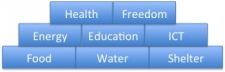 ICT = Information and communication technology |
In some cases, such as clean water, technologies are needed to avoid health issues plaguing groups without access to safe drinking water.
Currently a billion people lack access to safe drinking water, and 2.6 billion lack access to basic sanitation. As a result, half of the world’s hospitalizations are due to people drinking water contaminated with infectious agents, toxic chemicals and radiological hazards. According to the World Health Organization (WHO), just one of those infectious agents—the bacteria that cause diarrhea—accounts for 4.1 percent of the global disease burden, killing 1.8 million children a year.
As we can see, the number of child deaths alone is staggering. But, as they point out, Dean Kamen has invented the Slingshot, a system designed to purify polluted water for "less than one cent per liter."
Its inventions like those that have the ability to change the world by providing one of the basics every human requires for consistent health. Still, Kamen's water purifier requires energy to process clean water, which takes us to the next step on the pyramid. But clean water isn't the only goal. By providing clean water to everyone, there are less health issues. Less health issues means more time to develop, which means more intelligence and maturity. This should lead to healthier childhoods, which helps each generation outperform the previous.
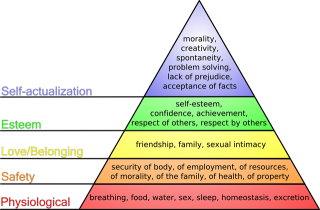 As each need is met, the individual is able to function at higher levels of the pyramid. In Maslow's hierarchy, this provides the opportunity to develop morality, creativity, spontaneity, problem solving, the lack of prejudice, and the acceptance of facts. On the Abundance Pyramid, this means health and freedom.
It's important to note why this is important. Sometimes, when I hear the word 'abundance' used, or the term 'an abundant future', many present and possibly receive the meaning as a world where consumer goods are extremely cheap. That isn't the point of abundance (Though Eric Drexler's proposed value of atomically precise manufacturing could make that happen as well). The point of abundance is using efficient technologies to provide the basics, providing a ladder for the world's impoverished to reach the highest level of the pyramids.
Is this the future? It is, but it is also the past and present. Technology has been providing for us since humans became scientists. One passage that highlights the benefits of abundance we receive every day focuses on light:
So how have people managed to save time over the years? Well, we’ve tried slavery—both human and animal—and that worked okay until we developed a conscience. We also learned to boost muscle power with more elemental forces: fire, wind, and water, then natural gas, oil, and atoms. But at each step on this path, we have not only developed more power, we’ve also saved more time.
Light is a fabulous example. In England, artificial lighting was twenty thousand times more expensive circa AD 1300 than it is today. But when Ridley extended the equation and examined how the amount of light bought with an hour’s work (at an average wage) has changed over the years, there is an even bigger savings:
Today [light] will cost less than a half a second of your working time if you are on the average wage: half a second of work for an hour of light! Had you been using a kerosene lamp in the 1880s, you would have had to work for 15 minutes to get the same amount of light. A tallow candle in the 1800s: over six hours’ work. And to get that much light from a sesame-oil lamp in Babylon in 1750 BC would have cost you more than fifty hours of work.
Put another way, if you compare today’s cost of lighting with the cost of sesame oil used in 1750 BC, you’ll find a 350,000-fold time-saving difference. And this covers only the savings of work-related time. Since those with electricity rarely knock over a lantern and set the barn on fire or suffer the respiratory ailments resulting from breathing in candle smoke, we have furthered gained those hidden hours once lost to poor health and habitat repair.
A future of abundance is one where access to food, water, and shelter provides the time to become educated. Access to energy, via solar or some other methods of production, means access to empowering technologies which provide communication and a greater range of educational tools. It means having a presence in the global conversation.
Once these needs are met, health is guaranteed. Shelter keeps us warm. Food gives us energy. Clean water keeps us hydrated and clean. Clean energy means clean air, free from the use of wood and coal stoves. Education means more medical knowledge so we can care for ourselves to avoid illness. Information and communication technology provides access to more information, information used to identify health issues early and perhaps to show and discuss issues with doctors far from the village.
Once these are provided, freedom should be a natural outcome. As they point out in the book, in an age of abundance, children and women spend less time procuring the basics and have more time to become educated and demand their own rights - time itself is a limited resource and a world of abundance provides more time to each human.
If you have any doubt, you might wonder if the book is accurate. Can we really live in a world of abundance? Can we trust them that things will improve? In addition to cheap light, there is other proof we're in the middle of vast improvement and have been for your entire life. To support this, they mention Hans Roling's TED talk on how the world has improved over the last century. It's 20 minutes long and well worth the time to watch.
As we can see, improvements are already happening. Expanding health care, as mentioned by Gates, is an important part of this movement towards longer lives and smaller families - which influences the Earth's long term population projections.
I'll end here, as this is another book too deep and broad to thoroughly quote for a complete review. But Abundance delivers what its authors intended: hope. The authors take the reader through the pyramid, explaining the issues that exist where and when those needs are not met. One by one, they build a better world as each need is provided for, showing what has already happened and where consistent improvement will benefit mankind. Not all issues can be solved directly with technology and that's not the point. Technology can offer efficient methods to give every human the basics so they can grow healthy and strong and gain enough education to better the world around them. By meeting these needs, humans are empowered to overcome these social issues and improve the world around them. That's the outcome of a world of abundance.
If you are worried about the future, Abundance is a great read everyone should take time to enjoy. This book has a permanent spot on my shelf.
Topics covered
Futurists will enjoy the topics explored in the book, including:
- Clear lessons on global issues, the numbers of incidents (such as deaths), and what they cost.
- Human needs and how they influence our lives
- The value of Earth's ecosystems (@$36 trillion per year)
- Negative bias
- The Internet of Things and how it will assist developing abundance
- Future food production
- Agroecology
- How ideas spread
- The future of education
- The future of health care
- Incentivizing the development of our future
- And many more
If you enjoyed this review and intend to buy this book, please consider buying through this link.
Your overall rating:
Quality of the work (writing, art, photography, etc):
How believable?:
How original?:
Story tags (elements of how we live):
- Commerce (trade)
- Communication
- Conflict (combat)
- Diet (food preparation and preservation)
- Education (learning)
- Energy management (energy creation)
- Flora and Fauna (living nature)
- Government (representation)
- Habitation (dwelling)
- Interface (tech control)
- Medicine (health)
- Recreation (play)
- Vocation (occupation)
- Weather (the elements)
Location of story:
Years into the future:
 Interested in the social impact of our future advancements, Daryl developed and built Regarding Tomorrow as a platform to share and discuss our collective hopes and fears of the future. Daryl's background is in education, including graduate studies in special needs and a masters in instructional technology from UVA's Curry School of Education. He has worked as a high school teacher and has over 10 years of university experience in the US and Canada.